Categories
Chevy/GMC

Generations of the Chevy Corvette

Chevy Corvette

The Chevrolet Corvette made history as the first true American sports car. With appearances in pop culture and an enormous fanbase, it’s impossible to understate the Corvette’s impact on the American automobile industry. Let’s look back at this sports car’s iconic history.

First Generation: 1953-1962 Corvette C1

First Generation: 1953-1962 Corvette C1

Designer Harley Earl created the Corvette as the American answer to the European sports car trend of the 1950s. Known as “Project Opel,” the original Corvette was underpowered yet visually striking. This early model underwent dramatic changes throughout its first 11 years on the market.

1953

1953 Chevy Corvette

The first Corvette concept car received a warm welcome at the 1953 GM Motorama show in New York City. Chevy realized it had something great on its hands and rushed the Corvette into production, manufacturing 300 cars by the end of the year. However, the hype around the car died down by the time it officially hit the market, and only 183 cars sold that year.

Although it did poorly on the market, the 1953 C1 Corvette was the epitome of 1950s style. All models featured the now-iconic “Polo White” fiberglass exterior, a cherry-red interior and a black canvas convertible top.

Internally, the car used a modified version of Chevrolet’s inline six-cylinder Blue Flame engine. More powerful than the engine used in Chevy sedans and coupled with a two-speed manual transmission, the Corvette Blue Flame could generate up to 150 horsepower.

1954

1954 Chevy Corvette

Chevrolet moved Corvette production to its Saint Louis, Missouri, plant, where it remained until 1981. Although the Missouri plant could produce up to 10,000 cars a year, it limited its 1954 run to 3,640 due to low sales.

Chevy made some notable aesthetic enhancements as well. In addition to swapping the black top out for a tan one and adding white-walled tires, GM offered customers three new paint colors:

  1. Black
  2. Pennant Blue
  3. Sportsman Red

The Blue Flame engine also got a camshaft enhancement that increased output by 5 horsepower. 

1955

1955 Chevy Corvette

1955 saw the end of the Blue Flame engine and the introduction of the new 4.3-liter small-block V-8 engine. This change was one of the most significant updates the Corvette ever experienced, as the V-8 has stayed with the Corvette line ever since.

The 1955 C1 also added the option for a three-speed manual transmission, which boosted its performance to rival the competing sports cars of its day.

1956-1957

1956 Chevy Corvette

Chevy made even more aesthetic enhancements to the 1956 model, including: 

  • Distinctive sculpted sides
  • Remodeled front end
  • New external door handles
  • Optional folding roof

Additionally, where previous models had used removable window curtains, the 1956 model added roll-down windows to the doors. 

A camshaft upgrade brought the V-8 engine’s capacity up to 210 horsepower when combined with the standard four-barrel carburetor. They also offered a high-performance carburetor that could increase output to 225 horsepower. 

GM enlarged the engine to 4.6 liters in 1957 and added a fuel-injection system and a new four-speed manual transmission. With the proper configurations, the engine could now reach up to 283 horsepower. 

1958-1960

1958 Chevy Corvette

Engine output remained consistent for the next few years, as most of the changes during this period were aesthetic. However, these changes seemed to pay off as the Corvette finally became profitable.

The 1958 model received a significant facelift with the introduction of the split-headlight design and new chrome accents. Interior upgrades included a new instrument cluster that moved the tachometer from the center of the dashboard to directly behind the steering wheel and below the speedometer, in the driver’s line of sight.

Aside from a one-off turquoise soft top, changes for the 1959 model year were minimal. Other new features included optional sun visors and a new gearbox handle. 

In 1960, Chevrolet also produced 140 Corvettes in Cascade Green, the rarest factory paint color option to date. Coming across one of these ‘Vettes today is a once-in-a-lifetime experience for most.

Second Generation: 1963-1967 Corvette C2
Second Generation: 1963-1967 Corvette C2

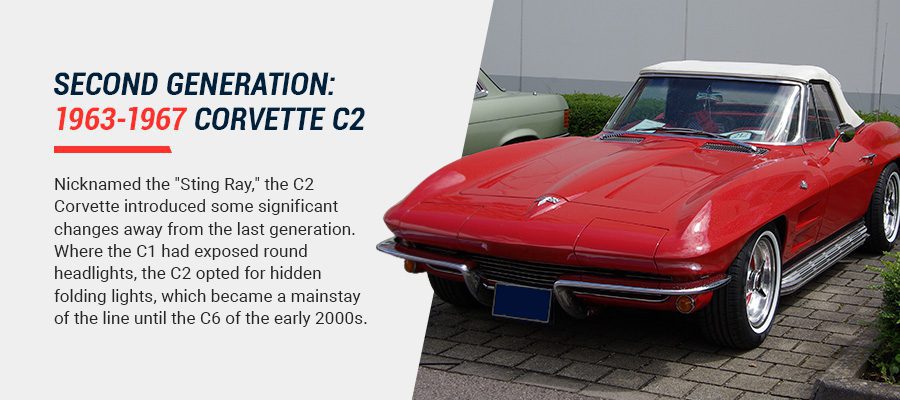
Nicknamed the “Sting Ray,” the C2 Corvette introduced some significant changes away from the last generation. Where the C1 had exposed round headlights, the C2 opted for hidden folding lights, which became a mainstay of the line until the C6 of the early 2000s.

The 1963 fiberglass coupe body ended in a new split-window design, but future models used a one-piece rear window instead. The 1963 model year was the only Corvette produced with that iconic split window, which is why it’s one of the most sought-after models in existence. Original Sting Rays in good condition sell for nearly $150,000 on average, according to market data.

The C2 cabin was also much roomier than the previous generation’s, providing a more comfortable ride.

1963: Regular Production Option (RPO) Z06

1963 Chevy Corvette Z06

Chevy knew the Corvette would appeal to the racing community, so it offered customers a special racing package for the 1963 model year. 

To apply the Z06 package, the customer first had to equip the 360-horsepower V-8 engine and a four-speed manual transmission, which was the most powerful combination available. Some key features of the Z06 configuration included: 

  • Dual master cylinder
  • Larger shock absorbers
  • Vacuum brake booster
  • Power drum brakes
  • More robust front anti-roll bar

Only 199 Z06 Corvettes sold that year, but the car’s impact on the racing community remained for generations to come.

Third Generation: 1968-1982 Corvette C3
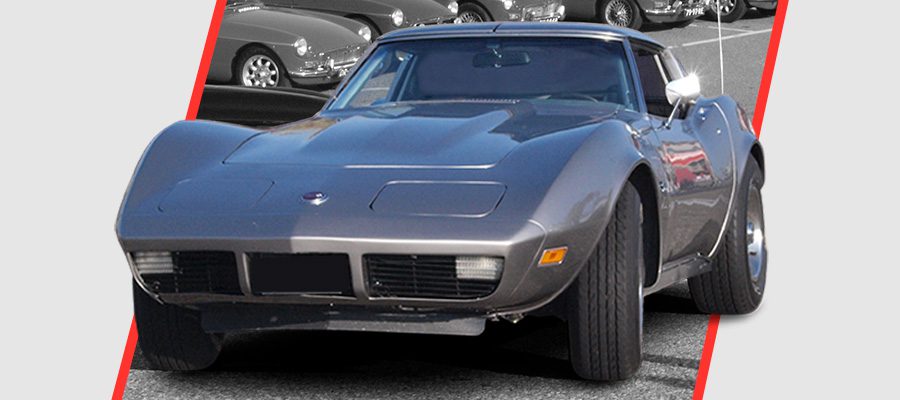
Third Generation: 1968-1982 Corvette C3

Chevy modeled the early C3s after two iconic concept cars — Larry Shinoda’s Mako Shark II (XP-755) and Bill Mitchell’s 1968 Manta Ray.

The Mako Shark II won the hearts of auto enthusiasts everywhere after its debut at the 1965 New York International Automobile Show. After a few years on tour, GM refabricated the Mako Shark II into a new concept car deemed the Manta Ray. With dramatic, sweeping roof lines and a sharp front splitter, the Manta Ray was a dazzling creation. You can see its influence in the C3’s new design.

1968

1968 Chevy Corvette

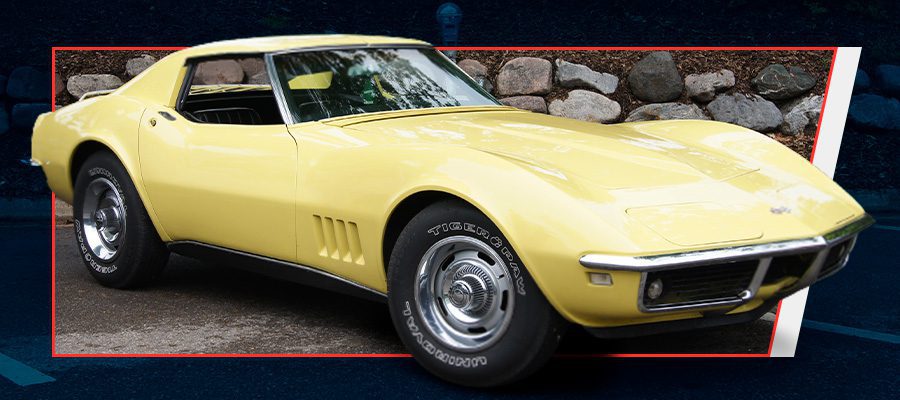
The 1968 C3 revolutionized the Corvette design with a sleek, streamlined body and a removable roof panel. Removing the original rear storage area allowed for a shorter back end, which became a staple of the Corvette silhouette for multiple future generations.

A new three-speed automatic transmission replaced the previous two-speed system, though the powertrain remained basically the same as the C2.

1969-1972

1969 Chevy Corvette

Although Chevrolet began to move away from the Sting Ray name at the start of 1968, the company decided to keep the name by the end of the year. The 1969 Stingrays — now one word — came with an improved 5.7-liter V-8 engine. 

Chevy also added power to their LS5 big-block engine, upgrading the stroke from 7.0 liters to 7.4 liters. At its max, the engine could generate up to 390 horsepower.

Due to public safety concerns over lead in gasoline, the U.S. introduced unleaded fuel and reduced octane requirements in 1970. Although this shift meant gasoline would be better for your health, it also meant the 1971 Corvette was less powerful than its predecessors.

1978-1982

1978 Chevy Corvette

The 1978 Corvette received an exterior design update that created a new fastback rear end and a little more interior storage space. Chevy tapped this car to pace the Indy 500 and produced 300 replica pace cars in commemoration.

In 1981, Chevrolet shut down its aging Saint Louis plant and moved Corvette production to its new factory in Bowling Green, Kentucky. 

1982 was a poor year for sales, marking the end of the C3. This final model only came with a 5.7-liter engine capable of 200 horsepower and a four-speed automatic transmission.

Fourth Generation: 1984-1996 Corvette C4
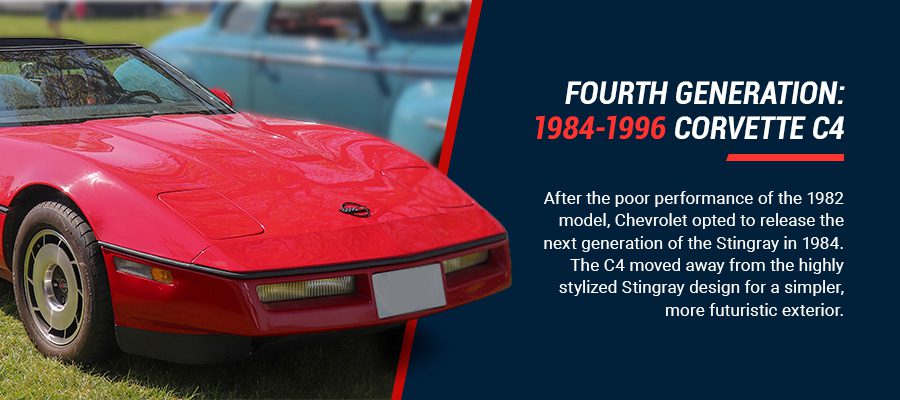
Fourth Generation: 1984-1996 Corvette C4

After the poor performance of the 1982 model, Chevrolet opted to release the next generation of the Stingray in 1984. The C4 moved away from the highly stylized Stingray design for a simpler, more futuristic exterior. 

While earlier generations used a body-on-frame assembly, the C4 used a uniframe. Unlike body-on-frame construction, where the car’s body is placed on top of a frame, the uniframe welds critical car elements into one connected unit. 

1984

1984 Chevy Corvette

While the new C4 had a lower center of gravity, it provided much greater ground clearance. It also offered new in-car amenities, such as a digital instrument cluster.

The 1982 C3’s small-block L83 engine carried over to the 1984 C4, providing a maximum of 205 horsepower. It also featured the same throttle-body Cross-Fire fuel injection system, which critics strongly disliked due to its less-than-stellar performance.

Drivers had the choice between a four-speed automatic transmission and the new “Doug Nash 4+3,” a four-speed manual transmission with an automatic overdrive on the first three gears. This option remained available until 1989, when the ZF six-speed manual transmission replaced it.

1985-1987

1985 Chevy Corvette

The C4 continued evolving throughout the ’80s, with a more powerful L98 V-8 engine and a better fuel injection system being added in 1985. In addition to being more fuel-efficient than its predecessor, this new engine could generate up to 230 horsepower and a max speed of 150 mph.

Additionally, Chevy brought back the convertible option for the 1986 model year after not offering it for more than a decade. They based this new model on the convertible pace car from that year’s Indy 500, installing a special commemorative plaque on the car. 

1990-1995: The Corvette ZR-1

1990 Chevy Corvette ZR-1

The ZR-1 was only available in a fastback coupe configuration, but it did include a removable roof panel for those who longed for the convertible experience. Its dual-overhead-cam 5.7-liter engine and ZF six-speed manual transmission could generate 375 horsepower. The car’s top speed was 175 mph, breaking speed records and creating one of the brand’s most iconic collectibles.

Chevrolet produced 84 ZR-1 Corvettes for the 1989 Geneva Motor Show, but the car wasn’t publicly available until 1990. It was available until 1995.

Fifth Generation: 1997-2003 Corvette C5

Fifth Generation: 1997-2003 Corvette C5

The C5 softened the C4’s sharp design with rounder edges and an all-new frame. Internally, it improved on many of the earlier generations’ pain points, creating what critics consider one of the first “everyday” Corvettes.

1997

1997 Chevy Corvette

The 1997 C5 introduced a new LS1 5.7-liter engine that could generate as much as 354 horsepower. The transmission moved further back near the rear differential. Customers could choose between a four-speed automatic transmission or a six-speed manual.

Additionally, this model featured a longer wheelbase and wider tire tracks, which reduced the car’s weight by approximately 80 pounds.

2001: Return of the Z06

In 2001, GM brought back the original racing package from 1963 with a few performance updates. First, they reduced the car’s weight by choosing thinner glass and titanium mufflers. 

They also tweaked the engine for more speed. The 2002 Z06 model was even more powerful with a maximum output of 405 horsepower.

Sixth Generation: 2004-2013 Corvette C6

Sixth Generation: 2004-2013 Corvette C6

The C6 made its debut at the Detroit Auto Show in 2004. This generation was faster and lighter than the C5, with some significant design changes. 

One of the most notable appearance changes was on the front end of the car. The 2005 C6 was the first Corvette in four decades to return to exposed front lights, a move that drew criticism from fans. 

Another important release was the Corvette 427 Convertible, which hit the market in 2013. While the Z06 was popular, it only came in a coupe body. To remedy the situation, Chevy took the Z06’s 505-horsepower LS7 engine and inserted it into the standard Corvette droptop frame to create a high-performance convertible.

Seventh Generation: 2014-2019 Corvette C7

Seventh Generation: 2014-2019 Corvette C7

The Corvette C7 introduced an all-new aluminum frame with a more aggressive design that appealed to younger customers. Chevy also returned to the Stingray name for the first time since the release of the C3. After the success of the mid-engine C8, the C7 was likely the last front-engine Corvette.

The 2014 release came with the option of a six-speed automatic or a seven-speed manual transmission, but the 2015 model year replaced the six-speed with an eight-speed automatic.

2019: Return of the ZR-1

2019 Chevy Corvette ZR-1

Chevy brought back the ZR-1 in 2019 with a new supercharged 6.2-liter V-8 engine capable of producing up to 755 horsepower. 

A seven-speed manual transmission came standard on the 2019 ZR-1. However, when equipped with the eight-speed automatic transmission, this Corvette offered excellent fuel economy. 

Eighth Generation: 2020-2023 Corvette C8

Chevy took an even more dramatic move away from tradition with its most recent Corvette generation, the C8. The most aggressive body styling so far, the C8 increased the size of the air intakes and sharpened the frame’s edges. 

This generation is also the first to use a mid-engine layout since the C1. Moving the engine further back in the car opened up additional storage space in the front

The C8 offers three trim options:

  1. 1LT: The 1LT trim offers an enjoyable ride with a 10-speaker Bose sound system and Bluetooth connectivity. It’s also equipped with an HD rearview camera for safety. Customers can choose between three interior color options — red, black or gray.
  2. 2LT: The 2LT is available in several more colors and offers more safety features than the 1LT, including a frontview HD camera, blind spot monitoring and rear cross-traffic alerts. It also offers maximum comfort with a heated steering wheel and temperature-controlled memory seats.
  3. 3LT: The 3LT takes all the standard features of the 2LT and adds some aesthetic enhancements, like genuine leather accents and two upholstery options.

Interestingly, GM also produced right-hand drive (RHD) C8s in-factory for international markets. The C8 was the first Corvette to receive this treatment since the original C1 — all other generations were manufactured as left-hand drive vehicles and modified upon arrival for the new market.

2020

The 2020 C8 came with a naturally aspirated engine capable of generating 490 horsepower and 465 foot-pounds of torque. Due to a lack of interest in a manual transmission, only an eight-speed automatic transmission was available.

Due to the COVID-19 pandemic, production for 2020 Corvettes stopped until 2021. People who had purchased a new 2020 C8 had to wait an additional year to receive it — and they often had to pay the 2021 price as well.

2023: An All-New Z06

Chevy brings back the Z06 for 2023 with its most powerful configuration yet. With a 5.5-liter V-8 redline engine, a dry sump oil system and variable valve timing, this race-ready Corvette can generate up to 670 horsepower and 460 foot-pounds of torque.

Unlike previous Z06 generations, the 2023 model is available in both coupe and convertible configurations.

Shop Corvette Restoration Parts From Raybuck Auto Body Parts

Shop Corvette Restoration Parts From Raybuck Auto Body Parts

If you’re a vintage Corvette owner, you might be looking for parts to restore it to its original condition. Whether you have a 1955 C1 or a 1986 C4 convertible, Raybuck Auto Body Parts can help you give your ‘Vette a new life. Our wide selection of new old stock parts includes door panels, seat covers and fuel tanks.

If you need help finding the right parts, we can help. Contact us today to speak with an expert.

Categories
Truck Talk

Top 10 Classic Pickup Trucks of All Time

Top 10 Classic Pickup Trucks of All Time

Some of the best classic trucks include various Ford, Dodge or Chevrolet models. For the truck enthusiast, repair expert or anyone who wants to know more about truck history, learning the top 10 classic pickup trucks can expand your knowledge and inform you about your next purchase.

Here’s a countdown of some of the best classic pickup trucks of all time.

10. 1975 Ford F-150

1975 Ford F-150

The Ford F-150’s first generation model was made with manual transmission. It came with driver- and passenger-side windshield wipers and washer fluid capabilities, making it a massive step forward in terms of Ford’s technological abilities.

The second-generation Ford F-150 models were made with new, updated engines. Ford updated the truck’s chassis and created a vehicle with a roomy interior and options for an inserted radio, lighter, dome light or armrests.

The 1975 Ford F-150 is one of the most popular versions in today’s classic truck market. The truck was known for its heavy-duty, beefy suspension capabilities and a gross vehicle weight of more than 6,000 pounds. Today, the F-150 has transitioned to all-electric. The Ford F-150 Lightning takes inspiration from the classic truck and is popular among consumers today.

9. 1956 Ford F-100

1956 Ford F-100

The 1956 Ford F-100 had a full-wrap or wrap-around style windshield. The wrap-around style included glass curved on each side of the pickup truck, meaning the truck had a smooth, bubbled aesthetic. Ford also changed the A-pillars to be more vertical than slanted, which was typical for other models.

The full-wrap rear window on many of the F-100s was named the “Big Window.” Big Window trucks are rare today, often containing a revised grille without the distinctive V-shaped top bar that many Ford enthusiasts know. The 1956 Ford F-100 is known for its classic and streamlined look.

The 1956 Ford F-100 is rare. Only around 6,000 were built during the era with Big Windows, meaning finding the pickup truck can be difficult. Due to its rarity and iconic design, the truck is highly sought-after in many circles. Many of the 1956 models available today can be seen in shows around the United States or at vintage meets where the pickup truck is sure to create buzz.

8. Chevrolet Cameo

Chevrolet Cameo

One of the most popular classic Chevy trucks, the Chevrolet Cameo housed a refined trim and car-style hubcaps. With an iconic two-tone paint job and smooth pickup bed, the Cameo turned heads wherever it went. Perhaps the biggest change from other Chevrolet trucks was the Cameo’s bed. With a larger shape and unique features like a hinged rear bumper housing a spare tire, the Cameo truck bed stood out among older models.

Featuring additions from other Chevrolet models, like tail lights with trim or a rear bumper like the Bel Air, many customers appreciated that the new model included standard Chevy pickup truck features.

The Chevrolet Cameo is a rare model. Only several thousand models were built, making it even rarer than some original Chevrolet models. Because of this, the Cameo is popular with collectors across the country and can be found at auction for hefty prices.

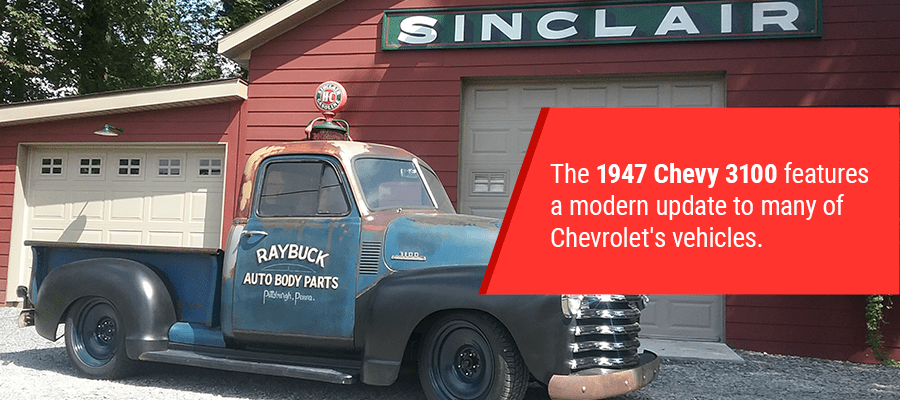
7. 1947 Chevy 3100

1947 Chevy 3100

The 1947 Chevy 3100 features a modern update to many of Chevrolet’s vehicles. The pickup truck had integrated fenders, a tinted windshield and a bigger truck bed for improved hauling. Chevrolet also gave consumers a choice between three engine variations and three payload sizes. With a broader, stable track, the Chevy 3100 was accurately named the “Advanced Design.”

Many car industries were involved in the WWII effort during this time, meaning that from 1942 to 1945, Chevrolet planned to market a new series truck post-wartime. The 1947 Chevy 3100 marked the beginning of a new design and improved technology for Chevrolet. The design of the post-war American vehicle is considered revolutionary.

6. Chevrolet C/K

Chevrolet C/K

The full-size Chevrolet C/K series ran from 1960 to 1999. Among the various generations, the second and third generations are highly sought-after by classic truck enthusiasts today.

The second-generation Chevrolet C/K models began in 1967. It created a basis for what many consumers now expect pickup trucks to look like and set the bar for modern pickup truck aesthetics.

The third-generation Chevrolet C/K model was nicknamed the “square body” truck. Built in 1973, the square body C/K had advanced updates and a well-engineered boxy design. Many appreciated the pickup truck for its comfort and spacious interior.

Finding many of the second- or third-generation models today can be difficult. If you stumble on the Chevy C/K, you’re fortunate. Because many models in the series ran for a limited time, classic truck enthusiasts and collectors make this a highly sought-after addition.

5. 1963 Jeep Gladiator

1963 Jeep Gladiator

The 1963 Jeep Gladiator was a modern and full-sized truck produced for over 25 years. With a large engine and powerful rear-wheel drive, the Gladiator made waves when it was first released.

The Jeep Gladiator is a rare find. It ceased production in 1971, only to return a few years later once the J-series was produced. With a different name that made it easy to distinguish from other Jeep models, the 1963 Gladiator is sought-after among many collectors and truck lovers across America.

4. 1991-1992 GMC Syclone

1991-1992 GMC Syclone

The 1991-1992 GMC Syclone was known to handle any and every terrain possible. It could even keep up with famous sports cars or performance vehicles, meaning you could drive with style and power. The Syclone also started the trend of performance pickup trucks that came with sports car capabilities. You could work and play in a truck like the GMC Syclone.

The GMC Syclone is a popular pickup truck among muscle car lovers and gearheads, meaning it’s sought-after in many classic truck circles. While the GMC Syclone is unique, it’s most remembered for its straight-line racing abilities. Those who enjoy a truck with power and speed will love the Syclone.

3. 1946 Dodge Power Wagon

1946 Dodge Power Wagon

The 1946 Dodge Power Wagon offered a consumer model to the general public. It featured a more extended cargo box and a wheelbase over 120 inches. With 94 horsepower and manual transmission, the truck had speedy, dual-power take-off. The Power Wagon could be used for many things, from hauling to pulling a plow to transporting a large family.

The Dodge Power Wagon could act as transportation and a tow truck simultaneously, offering plenty of power. With such intense strength and abilities, its post-war design is unique to the era, making it one of the most classic pickup trucks ever made.

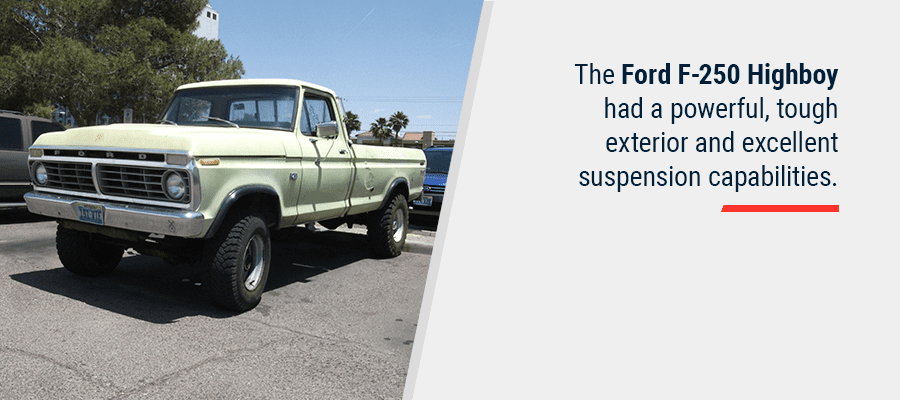
2. Ford F-250 Highboy

Ford F-250 Highboy

The Ford F-250 Highboy had a powerful, tough exterior and excellent suspension capabilities. Many consumers enjoyed that they could swap out tires with little to no effect on the suspension. One of the reasons the F-250 earned the name “The Highboy” was the popularity of swapping out the original 31-inch tires with 35-inch tires.

The suspension opportunities make it popular to this day. The style of the Highboy is iconic and recognized among many truck-enthusiast circles. With the rising popularity of the Highboy, the Ford F-Series quickly became one of the most loved pickups in America.

1. 1978-1979 Dodge Li’l Red Express

1978-1979 Dodge Li'l Red Express

The 1978-1979 Dodge Li’l Red Express is one of today’s most widely recognized and sought-after classic trucks. Back in the day, Dodge ran ahead of its competitors with the new addition of the Red Express. The truck could reach 100 miles per hour in less than 20 seconds and travel a quarter-mile in less than 15 seconds.

The Red Express was incredibly fast. It quickly rose in popularity and has become a classic pickup truck recognized in many truck-enthusiast circles. The iconic coloring and design, along with its incredible speed and power, mean the truck’s recognition has yet to be surpassed.

Find Quality Pickup Truck Parts at Raybuck Auto Body Parts

Shop Pickup Truck Parts with Raybuck

Raybuck Auto Body Parts offers high-quality truck parts and services for those who need fair pricing on restoration and replacement parts. Our company is a top supplier of aftermarket parts, whether you want to restore the parts to your Ford F-150 or want to find replacement services for your Chevy Cameo.

Contact us online today to speak to a representative or call us at 800-334-0230.

Categories
Restoration

Top 10 Most Popular Classic Vehicles to Restore

Most Popular Vehicles to Restore

A classic vehicle restoration project is an investment that leads to a transformation. Some popular classic muscle cars are easy and affordable to restore. Restoration tips can help you determine which vehicle is best for your car restoration project. 

Our list of the top 10 most popular classic vehicles will help you determine which cars are the best for a restoration project, which are the easiest to restore, which models are most readily available and which have the most affordable parts.

Chevy Camaro Restoration

1. Chevrolet Camaro (1967-1969)

One of the most popular classic cars to restore is a 1967-1969 Chevrolet Camaro. Chevy followed the pony car market started by the Ford Mustang with its Camaro. This compact performer is the first-generation Camaro and features every engine family among Chevy’s lineup, including the COPO-only 430-hp 427 cubic inch big-block and the 230 cubic inch inline-six. Manufacturers reproduce each part for this Camaro generation, including complete body stampings.

The first generation of Chevy Camaros comes with a rear-wheel-drive, F-body platform. Two models were built, including the convertible and the hardtop coupe. The hardtop coupe is more affordable and has more room for passengers, with two back seats and two front seats. Engine options for the first generation of Camaros included the 6.5-liter V-8 with 375 horsepower and the 3.8-liter straight-six reaching 140 horsepower.

Everything you need to rebuild a Camaro is available in brand-new condition due to the huge demand for these vehicles. If you’re looking to keep your restored car, they’re reliable, powerful and fun to drive, thanks to aftermarket performance parts. Get parts including the 1967 Chevy Camaro Molding Grille Upper and 1968 Chevy Camaro Windshield Molding Upper Inner.

Ford Mustang Restoration

2. Ford Mustang (1964-1968)

Another one of the top classic cars to restore is the 1964-1968 Ford Mustang. The Mustang was created out of a desire to make the 1960 Falcon a more enjoyable ride. The compact-class Falcon was a success because of its low cost and fuel consumption, but it needed sprucing up to be more fun. Following some failed attempts, a sport version of the Falcon was envisioned, and the Mustang entered the market, accelerating the race in muscle car production.

In its first year, more than 400,000 Mustangs were sold. Over the following decade, more than a million Mustangs were built. You may have seen the original Mustang in “James Bond Goldfinger” or the 1968 version in Steve McQueen’s “Bullitt.” 

You can find the parts you need online, and every part has been reproduced. If your dad’s Mustang is more rust than car, you can get an exact replica of the classic sheet metal and factory-spec interiors, including hardware.

Plymouth Barracuda Restoration

3. Plymouth Barracuda (1970-1974)

Being late to enter the market worked in Chrysler’s favor. After learning from competitors’ mistakes, Chrysler launched the Plymouth Barracuda in the 1960s. The Barracuda was built with a 108-inch wheelbase two inches shorter than the Dodge Challenger, a shaker hood package and a 425-hp Hemi big-block V-8. Every Barracuda comes with a sleek look regardless of power level, and decades later, the quantity of models is still keeping classic car fans busy.

If you want the most affordable models, purchase a 1973 or 1974 with the smaller 318 cubic inch V-8s or 340 cubic inch V-8s. Restoration is easy with a huge supply of new interior, trim and body parts. Each year, more parts are reproduced for the 1970-1974 E-body Plymouth Barracuda. Parts you can get for your Plymouth include:

  • Lights
  • Floors
  • Doors
  • Grilles
  • Hoods
  • Mirrors
  • Fenders
  • Bumpers
  • Interior trims
  • Exterior trims
  • Rocker panels
  • Wheel arches or quarter panels

Values will continue rising for small-block engine cars and later models. Demand for a Plymouth Barracuda will always exist, thanks to this car’s wide appeal and good looks. 

Chevy Bel Air Restoration

4. Chevrolet Bel Air (1955-1957)

Love ’50s-era Chevys? You’re in luck. The 1955-1957 Chevrolet Bel Air is perfect for restoration. Reproduction parts are still increasing in production — you can easily buy all the electrical and mechanical parts you need for a restoration project. High-performance upgrades, like disc brake conversions, are readily available. Since you can find every part needed to rebuild a Chevy Bel Air, including new body shells for the 1957 model, this is a great option for a restoration project.

Bel Airs have a huge fanbase across the world, so you can quickly sell your restored vehicle if that’s why you’re taking on the project. Parts often available for a Chevy Bel Air include the Nomad Floor Plan Panel Complete Hardtop/Convertible, the Nomad Door Exterior Handle Pair and the One-Fifty Series Windshield Weatherstrip Seal Without Trim Groove

Chevy Impala Restoration

5. Chevrolet Impala (1965)

One of the best antique cars to restore is the 1965 Chevrolet Impala. This fourth-generation Impala was among the best-selling car in America in the mid-1960s. Most 1961-1964 Chevrolet Impalas have been turned into low-riders or customized, which makes the 1965 model the next affordable Chevy. 

The 1965 model comes with six separate taillamps and a sloping roofline. In Super Sport trim, the Impala comes with a 427 cubic inch L72 engine with a whopping 425 horsepower. 

In 1965, the Impala retired the original X-type frame for a full-width perimeter frame. The 1965 Impala was also redesigned with: 

  • A pointier angled windshield
  • Customized full-coil suspension
  • Reshaped vent windows 
  • Frameless, curved side glass

This redesign was successful, selling more than a million units in the U.S. in 1965 and becoming the best year for the classic Impala. Though reproduction parts are more plentiful for early models, even the 1965 model has plenty of available new parts. This means even the rustiest car restoration project is easy to finish. Find Impala restoration parts for the 1958-1985 models, from replacement lamp bezels to mirrors and lock kits.

Chevy Chevelle Restoration

6. Chevrolet Chevelle (1964-1972)

The 1960s introduced midsize vehicles that supported the muscle car movement. General Motors became a leader in identifying ways to get big sales from younger buyers. They did so by taking an affordable intermediate passenger car and giving it a powerful V-8. 

In 1963, Chevy introduced the Chevelle, riding the muscle car upswing. As a muscular option without being overly bulky, the Chevelle bridged the gap between the Chevy Nova and the Impala. The Nova was compact, while the Impala was bulkier and larger. Those who wanted a vehicle in the middle ground could choose from several body styles, including a station wagon or sport coupe.

In 1964, Chevy replaced the original 220 horsepower engine with a 327 engine that maxed out at 300 horsepower. This high-performance vehicle is available in numerous styles. With the 115-inch wheelbase, the ride is smooth and easy. The basic body formula remained consistent through 1972 with few changes. This classic vehicle is still available in abundance and supported by specialized aftermarket companies, online forums, events and clubs.

Of all the A-bodied Chevelles sold between 1968 and 1972, a large number were SS models. A portion of those came with a big-block 454 V-8. At your local car show, you’re likely to find an SS 454 with the iconic cowl induction bulged hood. The A-body’s muscular look makes it a customizer’s dream, so parts are easy to find.

The most affordable models tend to be the 1971-1972 convertible and hardtop models. Thanks to the basic construction of body-on-frame, Chevelle restorations are straightforward projects. They’ll sell quickly and at a reasonable price with this model’s many admirers.

Pontiac GTO Restoration

7. Pontiac GTO (1964-1972)

If you’re looking for the best antique car to restore, try a 1964-1972 Pontiac GTO. One of the best moves Pontiac made was introducing a new muscle car concept to the world by taking the full-size Catalina’s 389 cubic inch V-8 and adding it to the midsize Tempest. Rather than compete with other pony cars like the Ford Mustang, the Pontiac GTO started a new segment of muscle cars. 

For the greatest affordability, consider a 1971 or 1972 model. If you want a GTO with the most power, go with an earlier model. Trim and body parts have been reproduced in abundance to enhance the performance of your vehicle. While values for the Pontiac GTO will keep rising for factory-correct, restored models, this classic car remains affordable for your restoration project. 

Dodge Charger Restoration

8. Dodge Charger (1968-1970)

The 1968-1970 Dodge Charger combines beauty and brawn, which is why so many enthusiasts consider this to be one of the best muscle cars of all time. For decades to come, the outstanding design of the Charger will keep this model one of the most popular classic vehicles to restore. You can obtain any mechanical part, and the list of reproduction body panels is growing every day. Rust can be a problem, as with any car from this era, but patch panels are widely available.

The amount of money and time that goes into your car restoration project depends on what condition you find the car in. But if you have time and skill, you can restore a Charger even in poor initial condition to its former glory. 

You’ll pay more for a bigger engine upfront, but this will add to the vehicle’s value when the restoration is complete. No matter which engine you choose, the Dodge Charger is one of the most iconic classic cars you’ll find. It’s fun to drive, fantastic to look at and handles well. 

Chevy Pickup Restoration

9. Chevy Advance Design Pickup (1947-1954)

Chevrolet’s Advance Design replaced 1941-1947’s AK Series of pickup trucks. These redesigns were considered sleeker and more powerful, with an appealing larger body than the AK Series. If you’re restoring the exterior of this pickup, you might be going for popular, unique colors like Forrester or Juniper Green or Transport Blue. You might even find 1954 two-tone, white-top cabs.

These pickups are just as popular today as they were during their release. Whether you’re restoring to resell or want to show off your Chevy at a truck show, your project is sure to have some eyes on it. When you’re looking for restoration parts, you might see models referred to as “1947-2nd Series” and “1955-1st Series.”

Pontiac Firebird Restoration

10. Pontiac Firebird (1970-1973)

Perhaps the best classic car to rebuild is the 1970-1973 Pontiac Firebird. Early second-generation Firebirds are highly sought-after now that prices for the first generation have soared. Enthusiasts love the Firebird for its understated styling, great proportions and classic Pontiac power. The Firebird comes with everything, including a 400 cubic inch V-8 and overhead-cam straight six. The Firebird offers something for everyone.

While the average enthusiast may not be able to afford a first generation, the 1970-1973 models are more affordable. We recommend the Trans Am and Formula models. Many reproduction parts are available, including new body panels. Though rarer than Camaros, the strong aftermarket support means surviving Firebirds have nearly limitless potential. You can easily restore and sell a Pontiac Firebird as long as you correctly restore the model to factory specs. For a classic with a cool 70s vibe, consider a Pontiac Firebird for your next car restoration project.

Vehicle Restoration with Raybuck

Find the Parts You Need From Raybuck Auto Body Parts

At Raybuck Auto Body Parts, we provide our customers with the best quality parts and service available. We have spent decades honing our parts line down to the best offered in the industry. Now, we’re a top supplier of aftermarket restoration parts for your classic car, light duty truck, van or SUV.

When you choose Raybuck, you’ll find quality parts for fair prices and a higher level of customer service. Whether you need replacement parts for your Ford, Chevy, Jeep, Dodge or Volkswagen, we have a wide selection of quality parts to choose from. Contact us at Raybuck to find the right parts for your classic car restoration project today!

Categories
Restoration

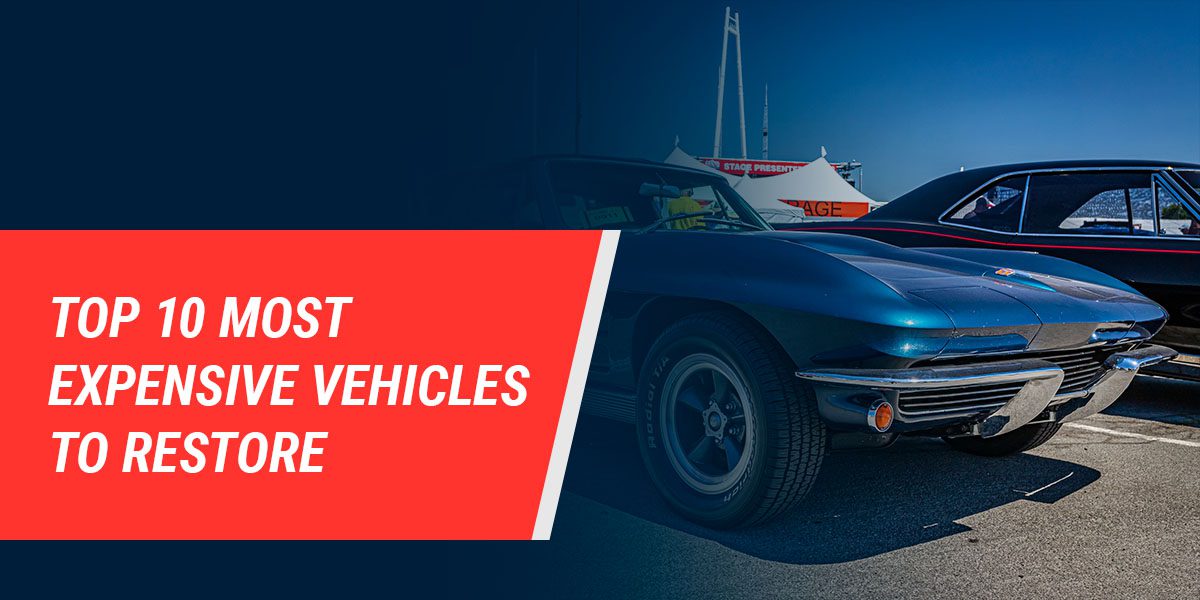
Top 10 Most Expensive Vehicles to Restore

Most Expensive Vehicles to Restore

Restoring a vintage vehicle to its original shape is a great way to spend your free time. No matter what kind of cars you enjoy restoring — from Corvettes to Aston Martins to Volkswagens — it is possible to stumble upon a model that may cost more than you anticipated. To ensure you are prepared for the amount of money you’ll spend, we’ve assembled a list of the 10 most expensive vehicles to restore. 

Plymouth Superbird Restoration

1. 1970 Plymouth Superbird

When the Dodge Charger Daytona hit the race track in 1969, its iconic nose cone and giant wing design inspired other manufacturers to make their own version. One year later, Plymouth created the Superbird for NASCAR racer Richard Petty, who won eight races with the famous blue Superbird design. 

Plymouth produced almost 2,000 Superbirds in the United States, 135 with the 426 Hemi V8 engine. This classic racecar was known to test speed limits with its advanced tire and brake technology. While its aerodynamics were superior to many race cars during the era, NASCAR considered them a safety issue that also gave an unfair advantage. NASCAR eventually banned the Plymouth Superbird from participating in races, and Plymouth ended production soon after.

Why Is Restoring the Plymouth Superbird Expensive?

Restoring the Plymouth Superbird is expensive because of its rarity and advanced specs. Since it originated as a NASCAR racer that can reach high speeds, it may cost several hundreds of thousands of dollars to buy and restore. Richard Petty’s original car even received bids up to $3.5 million

The Superbird can be a dream car for any restorationist or collector. While the Superbird requires specific, expensive parts that make the restoration costly, the earnings may justify the means for those who can afford the process. 

Corvette Sting Ray Restoration

2. 1963 Corvette Sting Ray

Chevrolet designed the fast and sporty 1963 Corvette Sting Ray to combine the characteristics of convertibles and fastback sports coupes. It was given the title by the original designer, who thought the vehicle resembled a sting ray and found that the name was a great marketing tool. This unique Corvette model incorporated many advancements, including updates in the car’s performance and handling and a hidden rear suspension under the tail. 

Why Is Restoring the Corvette Sting Ray Expensive?

Attempting to restore the Sting Ray brings on many expenses. For one, the model’s chassis and shorter wheelbase make it challenging to find parts to fix the car. The Corvette is famous for its improved steering and handling, making for a faster ride through distributed weight from the front of the car to the rear. While the vehicle experiences better traction and power steering overall, finding the correct replacement parts can be expensive. 1963 was also the only model year that included the famous rear split window.

3. 1963 Volkswagen Bus

Volkswagen Bus Restoration

The 1963 Volkswagen Bus is one of the most expensive vintage cars today. Volkswagen made this van with various configurations compatible with commercial use, camping trips or vacations. With additions like the bare-bones panel or the pop-top roof, the Volkswagen Samba Deluxe Microbus is still popular today. 

The Bus earned its nickname, the “23-window,” due to the added features of panoramic, curved rear, side, windshield and skylight windows throughout the design. From the iconic pivoting barn doors on the side to the recognizable two-tone color palette of classic 1960s luxury, the Volkswagen Bus was a hit among consumers everywhere. 

Why Is Restoring the Volkswagen Bus Expensive?

Restoring the Volkswagen Bus is expensive due to its size and the number of necessary parts. The 23-window version also had a much lower production run than vans without the skylight windows, which makes this particular version much more collectible. With a large sunroof, huge pivot doors and decorative trim, it takes a lot of time, energy and money to recreate the classic design. Availability of the numerous skylight windows is also an issue.

You’ll also have to take the color into account. Repainting a Volkswagen Bus requires more money overall due to its size, and it may be challenging to recreate the typical gray and white or red and brown tones the Bus is known for.

Pontiac Trans Am Restoration

4. 1973 Pontiac Trans Am SD-455

While early Pontiacs like the Firebird were known for their signature Coke-bottle body style — similar to the Chevrolet Camaro — second-generation models from 1970 to 1981 had curvier, swoopier bodies. 

When Pontiac developed the Trans Am SD-455 in 1973, it was known for its strong cylinder block, four-bolt main bearings, functional hood and added strength and material. While early pre-production SD-455s used the 041-spec cam during testing, the 1973 units contained a cam with a 744 grind.

Why Is Restoring the Pontiac Trans Am SD-455 Expensive?

Due to the car’s rarity, the restoration process can be expensive and finding the vehicle itself can be difficult. Of all the models produced, only 252 are Super Duty models. Because Pontiac produced the Trans Am SD-455 in such small numbers, many engine parts can be challenging to find. Many of its components have become rare since Pontiac discontinued the model, making the SD-455 one of the most expensive cars ever sold.

5. Aston Martin Lagonda

Aston Martin Lagonda Restoration

The Aston Martin Lagonda is one of the most expensive vintage cars. First designed by William Towns, with four solid doors and a futuristic frame, the Lagonda is known for its unique features and digital instrumentation. Since then, the Lagonda has received a few updates to enhance its futuristic features, including rounded edges, a new nose with smaller headlights and flared body panels with full-color coding. 

The Lagonda is so rare that Aston Martin built only 25 in the United States annually. During the 1980s, manufacturers even gave the car enhancements like hi-fi equipment, a wheelbase similar to a limousine and cocktail cabinets for late-night drinks.

Why Is Restoring the Aston Martin Lagonda Expensive?

Aston Martin Restoration

Due to the Aston Martin Lagonda’s experimental features, the vehicle is one of the most expensive cars to restore. Finding the right parts to replace the electronics and styled paneling of the frame itself can feel overwhelming if you don’t know where to look. 

Keep in mind that fixing one problem with the car may result in uncovering a few more. However, while restoring the car can cost a lot of time and money, having an Aston Martin Lagonda in your possession will be worth it.

Toyota MR2 Restoration

6. Toyota MR2

Toyota produced the first generation MR2 from 1983 to 1989 and introduced several updates in the second-generation styles from 1989 to 1999. While many overlook the MR2, it has established itself as one of those refined vintage luxury cars that houses a powerful engine and quality interior parts any restorationist would appreciate. 

Despite variations introduced in the following generations — such as the MR2 Roadster in Europe and the MR2 Spyder in the U.S. — Toyota eventually discontinued the vehicle because of low sales. The MR2 is rumored to be making a comeback soon, drawing many repairers back to the vintage versions of the Toyota. 

Why Is Restoring the Toyota MR2 Expensive?

While the Toyota MR2 is a reliable vehicle with an excellent turbocharger and lightweight engine, you should still expect many expenses while repairing it. You can find a great car in good condition in most generations of the MR2. However, the Toyota’s more petite frame means little room to work on the repairs. The waterline is also uniquely placed, meaning you must invest in special tools to fix it. 

Chevy Bel Air Impala Restoration

7. 1958 Chevy Bel Air Impala

The 1958 Chevrolet Bel Air Impala improved on earlier Bel Air models by including revitalized circle taillights, a two-spoke steering wheel and special extractor vents. It quickly became a popular design among other Chevy Bel Air lines of hard-top cars and convertibles. The Impala was known for its shorter stature and extended rear deck, with a longer wheelbase compared to low-price models of the same line. With bright moldings and decorative symbols on the side, many appreciated the Impala’s sculpted look and luxury feel. 

Why Is Restoring the Chevy Bel Air Impala Expensive?

Of all the cars restored over the years, the Chevy Bel Air Impala is one of the most expensive. Due to the model’s unique insignias and special molding, finding the right parts to restore the car will cost a pretty penny. The longer wheelbase also means you’ll need to invest significant research time to find pieces that fit a design that doesn’t match other Chevy Bel Airs. 

Mercedes 300SL Restoration

8. 1956 Mercedes 300SL Gullwing

The Mercedes 300SL Gullwing is a car that managed to circumvent post-war styles and create a luxury vehicle all its own. While the car is best known for its iconic gullwing top-opening doors, the Gullwing has also won many races across Europe and the United States. With trendsetting doors, stylish contoured panels and interior designs, the Gullwing is still one of the most influential models in the automotive industry. 

Why Is Restoring the Mercedes 300SL Gullwing Expensive?

Mercedes 300SL Restoration

Mercedes only produced 1,400 Gullwings from 1954 to 1956. As one of the rarest vehicles in the world, finding a Mercedes 300SL Gullwing in good condition can be a daunting task. Parts may be even more challenging to find, as Mercedes also produced many of the Gullwing’s components in small numbers. However, once you’ve completed the restoration, you may be able to sell your Gullwing for a few million dollars. While it may be expensive to restore, it’s worth the effort if you are lucky enough to find one in salvageable condition. 

Mercedes Benz 600 Restoration

9. Mercedes-Benz 600

The Mercedes-Benz 600 was made for a particular group of rich and royal owners and only produced in small quantities. Though it had the longest run of any Mercedes-Benz design, the company made fewer than 3,000 cars. This vehicle is known for a few basic frames, including the short-wheelbase Limousine, the longer-wheelbase Pullman Limousine and the convertible top Landaulet. 

The Mercedes-Benz 600 was a car for politicians, royal fleets, heads of state or industry billionaires — some notable passengers included Queen Elizabeth II, Ferdinand Marcos, Kim Il-sung and Mao Tse-tung, among many others. The luxury vehicle has spacious leg room, fantastic suspension, adjustable seats, incredible ventilation and power assistance during manual drive. 

Why Is Restoring the Mercedes-Benz 600 Expensive?

Due to its complex machinery and parts, restoring the Mercedes-Benz 600 can be costly — Mercedes built the vehicle for comfort over care for future maintenance costs. These luxury vehicles are engineered with such unique characteristics that finding replacement components can be complicated. With their complex hydraulics and power locks to the specialized sunroof and automatic doors, any restorationist will need extreme luck and skill to complete this project. 

Chevy Camero z28 LT1 Restoration

10. 1970 Chevrolet Camaro Z28 LT1

Compared to other Camaros, Chevrolet made the Camaro Z28 LT1 with a 108-inch wheelbase, a new engine and a coupe body. It came equipped with reliable lifters, big valves, aluminum pistons and a larger rear bumper. The Camaro Z28 LT1 also had a smaller grille and large headlights that enhanced the wider hood and revised dashboard. The overall effect was a sporty luxury vehicle with specialized features — like its centralized gauge cluster — that appealed to car fans everywhere.

Why Is Restoring the Chevrolet Camaro Z28 LT1 Expensive?

Restoring the Chevrolet Camaro Z28 LT1 can be expensive due to the extreme power the vehicle requires. Finding parts that fit the body style can also be challenging, as many of the components are very rare. You’ll need to invest several thousand dollars in acquiring the car and finding the right parts for this luxury vehicle. 

Get the Parts You Need From Raybuck Auto Body Parts

Shop Restoration Parts at Raybuck

At Raybuck Auto Body Parts, we provide quality autobody parts for aftermarket truck, van and car restoration projects at competitive prices. We also work hard to offer a higher level of customer service than our larger competitors. When you call us, you’ll reach a live person who can give you personalized assistance. 

Whether you’re restoring a Mercedes-Benz 600 or a Chevy Bel Air Impala, our salespeople know the parts you need and can help you through the restoration process. At Raybuck, you can find specialized parts for even the most expensive projects. Contact us today to speak to a representative or call us at 800-334-0230.

Categories
Restoration

Top 10 Cheapest Vehicles to Restore 

10 Cheapest Vehicles to Restore

If you’re looking for cheap old cars to restore, it may be time to consider some of the unique variations of Pontiac cars or the classic design of the Ford Mustang. Whatever you choose, research each part carefully to decide whether the rebuilding process will be straightforward and suitable for your budget. While some classic cars can be relatively expensive to repair, some cheap options make it easier to start the restoration process.

Explore 10 of the best cheap cars to restore below.

1. Pontiac Star Chief (1954-1966)

Among the cheapest cars to rebuild is the Star Chief. Made between 1954 to 1966, the Star Chief balanced between a full-size car with a luxury feel and a light, compact frame. With signature chrome suspenders and the iconic Silver Streak trim along the trunk and hood, the Chief’s long wheelbase and unique design stood out among Pontiac variations.

Restorationists may also enjoy working with the Pontiac’s engine, which links the machinery of the Sloan-era Pontiac with the Excitement Division design.

Why Restore the Pontiac Star Chief?

Pontiac Star Chief Restoration

While the Pontiac Star Chief is on the higher end of the classic car price range, you can still find a running car for around $4,000. The attractive post-war design with unique fins and ornamentation of the early 1960s makes the Star Chief a great car to restore. Enjoy the V-8 options with solid horsepower and all of the available parts to enhance the vehicle.

Pontiac Trans Am Restoration

2. Pontiac Trans Am (1978-1981)

The Pontiac Trans Am is a notable classic of the highways, high school lots and racetracks. From television shows to famous movies, the car has found its way into all parts of American culture, making it one of the best cars to restore when you also consider the cost to do so.

With many notable additions and elements, as well as the sleek signature curves and raw horsepower of the late 1970’s engines, the Trans Am has excellent street performance, refined handling and beautiful style. From the iconic General Motors, the Trans Am solidified itself in history as one of the most memorable cars of all time. 

Why Restore the Pontiac Trans Am?

The Pontiac Trans Am is a popular classic car, offering you a piece of history that will impress other collectors. What’s better is that it’s economical to restore this vehicle, as many people sell parts and accessories from the period that will fit the Trans Am perfectly. The models from 1978 to 1981 are both budget-friendly and reliable vehicles to work on.

Oldsmobile Cutlass Restoration

3. Oldsmobile Cutlass (1968-1972)

While the Oldsmobile Cutlass has a conservative design, the reflective material across the back of the car makes it a unique model. With a well-designed dashboard and stylish air vents, the Cutlass comes with live cruise controls on the steering wheel, antilock brakes and dual airbags, making it a great classic with a modern feel. Many collectors enjoy the Oldsmobile Cutlass for its comfortable interior and competent mechanics.

Why Restore the Oldsmobile Cutlass?

This popular vehicle is affordable among classic muscle cars, and many full models still exist on the market in decent shape. While the Oldsmobile is known for its luxury design and comfortable interior, making it a popular option, it’s not so rare that you can’t find one or the original parts in good condition.

Many of the Cutlass chassis parts are interchangeable with other General Motors’ A-body type cars from similar eras. This means purchasing brake and suspension parts is easy and affordable. This rare classic comes reasonably priced and will be a great addition to your restored car collection.

Just remember that exterior or trim parts may not have been reproduced as much as in other models, making them more difficult to locate.

4. Ford Mustang (1979-1993)

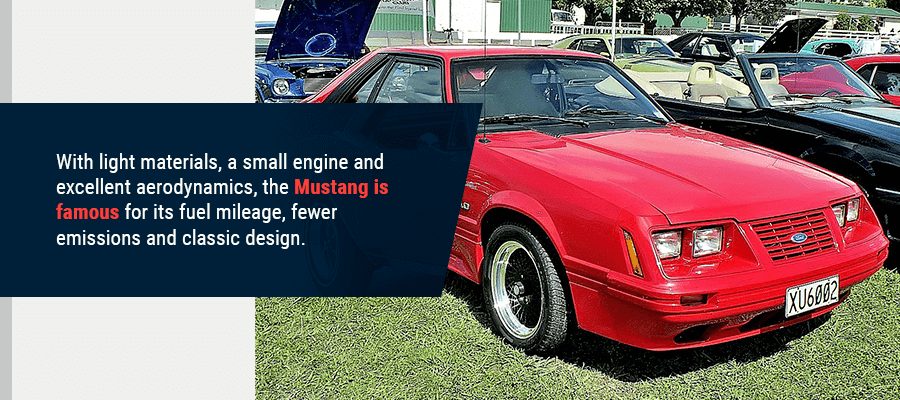
The Ford Mustang is one of the cheapest cars for repair work you can find. With light materials, a small engine and excellent aerodynamics, the Mustang is famous for its fuel mileage, fewer emissions and classic design. From the 1979 Pace Car to the 1982 debut of the 5.0-liter HO, the Mustang’s engine boasted a new GT with 225 horsepower capabilities in the 1987 to 1993 models.

Many Ford Mustang parts are easy to find on the market, with the car reasonably priced depending on the model. This makes it a great collectible and another fantastic restoration project. The straightforward design and mechanisms also mean repairing the vehicle is easier than ever.

Ford Mustang Restoration

Why Restore the Ford Mustang?

The Ford Mustang has a design that’s aged well, and you’re sure to get your money’s worth for a car that has been produced many times. It’s also easy to find videos or manuals and a large abundance of replacement parts and machinery to help you repair the vehicle.

Whether you plan to contact local experts or restore the car yourself, you can check websites or local catalogs for spare parts and community support. Restored Mustangs are known to sell themselves once you’ve put in the effort of making one look as good as new.

Chevy El Camino Restoration

5. Chevrolet El Camino (1978-1987)

The Chevrolet El Camino was first produced in 1978. With an iconic style, suspension and wheelbase inspired by the Malibu station wagon design, the vehicle offered sheet metal doors, front bumpers and a unique chassis when it first came onto the market. This vehicle eventually stopped being produced in 1987. Though interest in the El Camino eventually waned, people have started to look to the car again for restoration purposes.

Why Restore the Chevrolet El Camino?

Because the Chevrolet El Camino has such a distinctive look and a popular G-body platform, it’s one of the cheapest cars to repair. Over the years, the car has become a notable fixture in TV shows and movies — the epilogue movie for “Breaking Bad” is even called “El Camino.” If you’re interested in restoring a more unique-looking car that has regained its popularity, the El Camino could be the best option for you.

Buick Electra 225 Restoration

6. Buick Electra 225 (1971-1976)

If you’re looking for a car with a large engine, emission reducers and a machine that cuts back on horsepower, restoring the Buick Electra 225 may be an excellent project. The Electra is easy to steer and drive on back roads or highways for the repairer who enjoys cars with more modest components. The seats make for a comfortable road trip with friends or family, with interior wood trim and stylish chrome edging, and the Buick Electra 225 is known for its quality sound and interior speakers.

Why Restore the Buick Electra 225?

When looking at cheap cars for repair, the Buick Electra 225 ensures you’ll get an excellent vehicle for a low amount of money. With more interior room to work with, this General Motors classic allows you to replace more parts to create a luxury feel. Compared to earlier versions of the 224, some of which featured a convertible drop-top, these later models offer you a more affordable chance at restoring one of these classics.

Studebaker Lark Restoration

7. Studebaker Lark (1959-1964)

The Studebaker Lark offers an excellent opportunity to find spare parts and update your technical understanding of classic cars. With such a massive stockpile of old parts that went to resellers after manufacturers halted production, it won’t be hard to find parts today at a reasonable price.

Though the Studebaker Lark is sometimes forgotten among car repairers, it exists in the same market as other compact cars like the Falcon, Chevy Nova and the Dart. The Lark has received a few makeovers throughout its run, with the first generations from 1959 to 1964 standing out among the others.

Why Restore the Studebaker Lark?

Restoring a Studebaker Lark can be a great conversation starter, as many markets don’t offer these cars fully repaired, and you may be able to find one in good shape. With a few thousand dollars in hand, you can purchase one in decent condition and find some extra parts to get started. This is a truly unique car to round out your restoration lineup.

AMC Rambler Marlin Restoration

8. AMC Rambler Marlin (1965-1967)

For those familiar with the Tarpon, the AMC Rambler Marlin has a similar style and frame, sitting a few inches higher with a 112-inch wheelbase. With a notable fastback roof, rear fenders and an iconic grille and hood ornament, the AMC Rambler Marlin seats six people and is known for its durable suspension and reclining seats.

Why Restore the AMC Rambler Marlin?

Restoring the AMC Rambler Marlin allows you to work with fastback glass and interchangeable engine capabilities. Because many Marlins have gone through engine swaps, it’s possible to try several mechanisms underneath the hood and see what happens. While there isn’t a big collector market for the AMC Rambler, this is your chance to build a following for the classic car and add a unique vehicle to your restored car collection.

9. Dodge Dart (1963-1966)

Dodge Dart Restoration

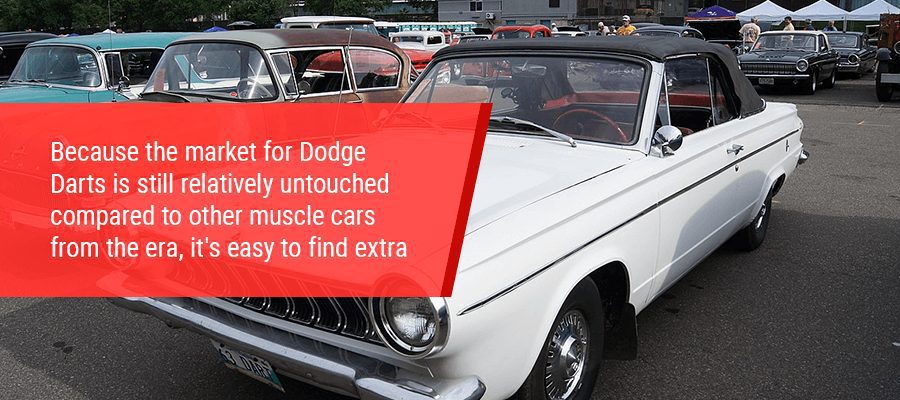
The Dodge Dart has seen five different body designs throughout its run but is most iconic for its four-door sedan, two-door sedan and two-door hard-top versions. From convertibles to station wagons, the Dodge Dart has three trim designs and a frame that’s overlooked compared to other classic cars. First-generation Dodge Darts are primarily known for their timeless three-box American design.

Regarding restoration, the Dodge Dart made between 1963 to 1966 has an appealing, unique look and a sophisticated feel unmatched by other versions. Because the Dart shares many parts and underpinnings with later vehicles, it’s easy to find the mechanics for the restoration process.

Why Restore the Dodge Dart?

Because the market for Dodge Darts is still relatively untouched compared to other muscle cars from the era, it’s easy to find extra parts for restoration. You can find parts for the engine or the car for under a few thousand dollars and many of the six-cylinder versions of the Dart for a very low price.

Pontiac GTO Restoration

10. Pontiac GTO (1971-1972)

The Pontiac GTO is one of the last classic muscle cars from the era and has a lot going on in terms of engine power, style and performance. The V-8 engine is known to be reliable. The frame and design of the GTO have a very bold appearance that makes it stand out from other muscle cars. Many old advertisements claim that the Pontiac GTO is one of the fastest Pontiacs ever made.

Why Restore the Pontiac GTO?

Aside from being classic muscle cars, many models from 1971 and 1972 are affordable and easy to find. While this specific era might mean you miss out on the power of earlier Pontaic models, it still offers an excellent opportunity to update the vehicle. The GTO is known to be a popular and sought-after classic among restoration enthusiasts, so you’re sure to find the repair process rewarding even if you don’t end up selling it when you’re done.

Get the Right Parts for a Great Price From Raybuck

Car Restoration Parts from Raybuck

When you’re venturing into the restoration process, Raybuck Auto Body Parts is here to help you find a variety of reliable parts for a great price. Our company was established in 1985 and has since built a reputation for offering quality parts for restoration or replacement needs. Our reliable sales team can help you find the right products at competitive prices to help you maintain and restore your classic cars.

Contact us today to speak to a representative about our automotive parts selection or call us at 800-334-0230.