Categories
Just For Fun

The Fall Guy 1981 GMC K-2500 Pickup Truck

fall guy truck jumping

The Original Fall Guy Pickup Truck: A TV Icon on Wheels

When it comes to classic TV vehicles, few are as memorable as the pickup truck from The Fall Guy. This action-packed adventure series, which aired from 1981 to 1986, followed Colt Seavers, a Hollywood stuntman who moonlighted as a bounty hunter. The truck was driven by Colt Seavers, played by Lee Majors, and his stuntman buddy Howie Munson, played by Douglas Barr. During most episodes, Seavers performed daring chases, high-flying stunts, and off-road pursuits, but the truck was also featured in several episodes as the main mode of transportation for the main characters. For their moonlit escapades, they used the truck to chase down criminals and fugitives, as well as to escape from dangerous situations—all while behind the wheel of one of the most iconic trucks in television history.

The truck that stole the show was a 1981 GMC K-2500, though throughout the series, multiple model years from 1980 to 1986, and models, were used. The original pilot used a GMC High Sierra, while seasons 1 and 2 used GMC Sierra Grande trucks, and seasons 3-6 used a combination of GMC Sierra Grandes, 1983-1984 GMC Sierra Classics, and GMC High Sierras for the jump trucks. GMC trucks of this era, also known as Square Bodies, were known for their durability and powerful V8 engines, making them an ideal choice for the demanding action sequences.
Fall Guy stuntman associationAlso known as the “Jump Truck,” the K-2500 was an integral part of the show and was used in many of the series’ action sequences. It featured a number of custom modifications, including a reinforced frame, heavy-duty suspension, a winch, roll cage, and a special “jump” ramp that was used in many of the show’s stunts. This heavy-duty 4×4 pickup featured a distinctive brown and gold paint job, “Fall Guy Stuntman” logo on the hood, and a black roll bar with KC lights mounted on top. Its rugged, lifted suspension and oversized off-road tires made it perfect for the daring jumps and rough terrain it had to endure in nearly every episode.

The show’s jump trucks actually had their 350-cubic-inch V8 engine moved from under the hood to under the hump seat in the middle of the truck to give them better balance as they flew through the air. Previously, the regular trucks were loaded with ballast in the bed to keep them from landing on their noses, but the added weight caused more problems.

fall guy truck secret compartmentThere are a lot of one-off modifications and accessories that appear on different versions of the truck throughout the series, but one thing that occasionally shows up in close-up scenes is the secret compartment Seavers had built into the bed. This compartment was accessed through doors “hidden” in the sides on the square body. These doors probably would have come off, or caused problems, during stunt work, which is most likely why they are not seen throughout all filming.

One of the most famous aspects of The Fall Guy truck was its ability to take flight. Thanks to the magic of Hollywood stunt work, the GMC K-2500 would soar over obstacles, launch off ramps, and crash-land without skipping a beat. While the show often depicted the truck performing extreme stunts, behind the scenes, several identical trucks were used to ensure production could keep up with the damage caused by the high-impact filming. The show’s stunt coordinators frequently rebuilt or replaced damaged trucks to ensure continuity throughout the series. Even though the trucks were equipped with heavy-duty suspension modifications to withstand the jumps, many were reportedly destroyed during production due to the intense action scenes and hard landings.

Interest in the Fall Guy truck has been reignited with the 2024 Fall Guy movie, starring Ryan Gosling. While the original GMC K-2500 won’t be making a comeback (even though a look-a-like is featured in the film), the film pays homage to the classic vehicle with a modernized brown and gold GMC Sierra 1500 AT4X stunt truck.

Even though The Fall Guy series ended in 1986, the GMC K-2500 remains a beloved piece of television history. It has since become a sought-after collectible, with fans restoring replicas to match the original truck’s iconic look. For fans of classic television and iconic vehicles, the Fall Guy truck remains one of the greatest TV trucks of all time. Its combination of power, durability, and Hollywood flair ensures its place in automotive and pop culture history. Whether in the air or on the ground, the Fall Guy pickup will always be remembered as the ultimate stuntman’s ride.

Categories
Just For Fun

The Starsky and Hutch 1975 Ford Gran Torino

gran torino starsky hutch

The Starsky and Hutch 1975 (and 1976) Ford Gran Torino is one of the most iconic TV show vehicles of all time. The Torino was a centerpiece of the popular 1970s television series of the same name, and driven by the titular characters David Starsky (Paul Michael Glaser) and Ken “Hutch” Hutchinson (David Soul). The bright red Gran Torino, with its distinctive white vector stripe running down each side of the car and over the roof, was known for its high-speed chases and stunts, which helped to make the show a hit with audiences.

Known for their unorthodox tactics to get the job done, the two detectives used the car for chasing criminals and solving crimes. They, and the car, were often seen driving around the streets of fictional Bay City, California, occasionally meeting up with their main confidential informant, Huggy Bear (Antonio Fargas). But the car was a character in its own right. It took on its own personality and was known for its ability to get the detectives out of tough situations, something that mere mortal cars could not do. An interesting note that Glasser admitted to in the “Behind The Badge” interviews, is that he had an immediate dislike for the car. At the first viewing of the car with David Soul, Glaser remarked that the car looked like a “striped tomato”. That nickname stuck, and the show’s writers started working it into the show as Hutch’s derogatory name for Starsky’s beloved Torino.

The show’s creators originally wanted to use a Chevrolet Camaro convertible, but chose the Ford Gran Torino because of the Studio-TV Car Loan Program that the producers’ company was involved in. The pilot episode used two 1975 351 Windsor V8-powered (VIN code “H”), “Bright Red” (paint code 2B) 2-door Gran Torinos, the first season cars used 400 V8s (VIN code “S”), and following season cars used 460 Lima V8s (VIN code “A”). The powerful V8 engine made the car well-suited for the fast-paced action of the series. The car featured a “shaker” hood scoop, which helped to increase airflow to the engine, as well as a rear spoiler, custom wheels, and a police spotlight. The interior of the car was black, with black vinyl seats (with the exception of the first season car which had black cloth seats), and was also customized with a CB radio, police scanner, and a microphone for the characters to use while on the job. And don’t forget the flashing police light that the characters would stick to the roof during their high speed chases!

1975 gran torino interior

Air shocks were used to give the rear of the car its aggressive stance, and Ansen Sprint 5-slot mag wheels accommodated larger rear tires. The tires were mounted black wall side out to avoid display of unauthorized brand-name display. In the first-season episode “Kill Huggy Bear”, a close-up shot of the villain cutting the rear brake lines shows Firestone letters on the inside of the tires.

Ford Torinos (non-police editions) originally came factory with a 2.75:1 ratio rear axle gearing. The Starsky & Hutch Torino rear end gearing was reportedly replaced with a higher gear ratio to provide quicker acceleration. In the second season, a label prominently attached to the dashboard read “DO NOT EXCEED 50 MPH”, presumably because the high rear end gearing could cause the engine RPM to increase beyond what the engine could reasonably handle, leading to engine damage or failure.

The show ran from 1975-1979, but despite its relatively short existence, the legacy of the Starsky and Hutch car lives on. The car has been featured in numerous films (including the 2004 Starsky and Hutch movie starring Ben Stiller and Owen Wilson as the two detectives), television shows, and video games. The car has also been the subject of countless merchandise, including models, toys, Legos and clothing. Many fans of the series still own replicas of the car, and the Gran Torino remains a popular choice among car enthusiasts. The show and the car have become a part of pop culture history, and will likely continue to be remembered for years to come.

If you’re restoring a Ford Torino, check out our Torino restoration parts.

Categories
Just For Fun

Herbie the Love Bug – 1963 Volkswagen Beetle

herbie the love bug

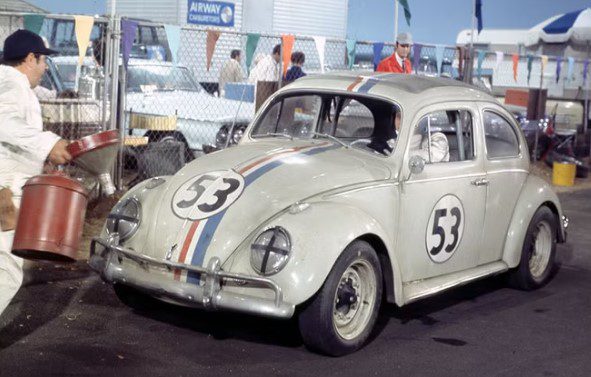
Herbie the Love Bug is a beloved character from the Disney franchise of the same name. The car, a 1963 Volkswagen Beetle Model 117 Deluxe Sunroof Sedan, wearing those iconic red, white, and blue racing stripes, and donning the number 53 racing number, is known for its mischievous and lovable personality.

The original Herbie film, “The Love Bug,” was based on the book “Car, Boy, Girl” by Gordon Buford, and was released in 1968 starring Dean Jones as race car driver Jim Douglas and Herbie as his trusty car. The film was a huge success and spawned several sequels, including “Herbie Rides Again” (1974), “Herbie Goes to Monte Carlo” (1977), “Herbie Goes Bananas” (1980), and “Herbie: Fully Loaded” (2005). The original film was the final live-action film authorized for production by Walt Disney himself, but since he died in 1966, he never saw the final cut.

One of the things that made Herbie so special was his ability to think and act on his own, often getting into mischief and hijinks. In the films, Herbie was often shown displaying human-like emotions and even had a “mind of his own,” often choosing to disobey his owner’s commands.

Herbie was also known for his love of racing. In the films, he was often seen participating in various car races and competitions, using his intelligence and quick thinking to outsmart his opponents. His signature racing moves included the “Herbie Shake,” in which he would shake his body to throw off pursuing cars, and the “Herbie Hop,” in which he would use his front wheels to jump over obstacles.

The car that played Herbie in the films was a modified 1963 Volkswagen Beetle. It was painted in Volkswagen L87 pearl white and had a white interior, but for the film they painted the Beetle gray so that it would not reflect studio lights. The car was equipped with a variety of special features, including a hidden control panel, a smoke generator, and a loudspeaker system. The car was also modified to be able to drive itself, allowing it to perform its own stunts in the films. An interesting note about the car is the word “Volkswagen” is never mentioned in the original film because VW did not give Disney the rights to use it. In fact, the car was stripped of all VW markings and was referred to as “the Douglas Special,” “the little car,” and “the compact car.”

The producer of The Love Bug, Bill Walsh, came up with the blue and red racing stripes, and gave the car No. 53 in honor of one of his favorite ballplayers, Don Drysdale of the LA Dodgers.

The original Herbie car was built by George Barris, a custom car builder who is best known for creating the Batmobile for the 1960s Batman TV series. Barris, more popularly know for his outlandish car builds, kept the modifications to this Beetle more subtle, including carrying the racing stripe over the canvas roof. Barris built three Herbie cars for the original film, and several more for the sequels. Both 1963 and 1966 model Beetles were used in the sequel, which you can spot by the varying size of the rear window.

The Herbie cars have become iconic symbols of the franchise and have been featured in various forms of merchandise, including toys, books, and clothing. The cars have also been featured in various theme parks, including Disney’s Hollywood Studios and Disneyland.

In recent years, there has been a resurgence of interest in Herbie and the Volkswagen Beetle. The car remains a popular choice among car enthusiasts and continues to be a beloved and nostalgic symbol of the 1960s and 1970s.

If you own a classic Volkswagen Beetle that’s in need of some love, you’ll want to check out our selection of Volkswagen Beetle restoration parts here.

Categories
Just For Fun

Mad Max 1973 Ford Falcon XB GT Coupe Interceptor

mad max ford falcon interceptor-banner

The Ford Falcon, featured in the iconic Mad Max film franchise, has become a cult classic among car enthusiasts and fans of the series.

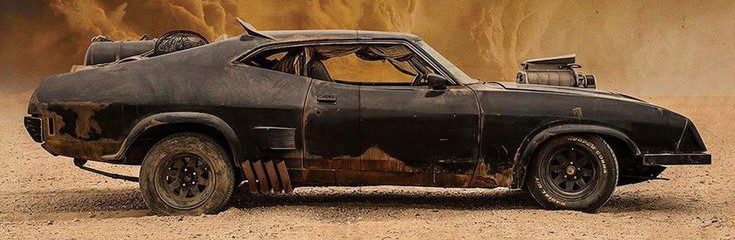
The original Mad Max, released in 1979, featured a 1973 Ford Falcon XB GT Coupe as the vehicle driven by the protagonist, Max Rockatansky, portrayed by Mel Gibson. The car, known as the “Interceptor” (aka V8 Interceptor, Last of the V8 Interceptors, or Pursuit Special), started out as a standard, white 351 cu in Australian-built Falcon, but was customized with a (non-working) Weiand 6-71 supercharger, nitrous oxide injection, roof and boot spoilers, wheel arch flares, front nose cone and air dam, exhaust side pipes, and various other modifications to make it a formidable force on the road.

The base-model Falcon was turned into a police interceptor for use by the Main Force Patrol (MFP). The MFP were the Australian Federal Police special task force in the movie, and their mission was to control the country’s ballooning crime rate. They would work hand-in-hand with the standard police to combat biker gangs and other savage criminals, hence the need for such a beefy vehicle.

In the sequel, The Road Warrior, a new Ford Falcon, a 1975 XB GT Hardtop, was used as the Interceptor. This version of the car was heavily modified with a new body kit, removal of the front air dam, a functional supercharger, a pair of large cylindrical fuel tanks mounted on the rear, and a matte black finish.

The third film in the franchise, Mad Max Beyond Thunderdome, featured yet another Ford Falcon, this time a 1977 XB GT Sedan. This version of the Interceptor was modified to include a turbocharged engine and a new paint job, making it one of the most memorable versions of the car in the series.

The Ford Falcon’s role in the Mad Max franchise cemented its place in pop culture history, and it remains a sought-after vehicle among car enthusiasts and fans of the series. The car’s rugged, no-nonsense design, combined with its high-performance capabilities, make it a perfect fit for the post-apocalyptic world of the films.

The Ford Falcon is not only a great car for the movies but also an iconic car for the Australian automotive industry. The Ford Falcon was produced in Australia from 1960 to 2016. It was a symbol of the country’s manufacturing industry, and it was a popular choice among car buyers in Australia.

If you have a Ford Falcon that looks like it was part of the Mad Max series, check out our Falcon restoration parts here.

Categories
Just For Fun

Sanford and Son 1951 Ford Pickup Truck

The Sanford and Son truck, also known as the “Funny Van,” is a beloved piece of television history. The show, which aired on NBC from 1972 to 1977, followed the antics of Fred Sanford (Redd Foxx) and his son Lamont (Demond Wilson) as they ran a junkyard and salvage business in Watts, Los Angeles. Each episode started with the famous “The Streetbeater” theme song written by Quincy Jones (if you grew up in this time, you know you can hear this song playing in your head right now), and the faded red and white 1951 Ford F-100 pickup pulling up to the house. The ’51 Ford was featured prominently in the show and played a key role in many of the episodes. The six-cylinder, three-speed truck was owned by Sanford and Son Salvage and was usually shown parked outside of the Sanford home.Sanford and Sun patch

The truck was used by Fred and Lamont to haul scrap metal and other items to and from the junkyard, and was also used for various “side hustles” that the two would undertake to make extra money. These included using the truck to haul away unwanted items for neighbors (think the OG 1-800-Got-Junk!), or to transport goods for local merchants. The truck was also used as a “company car,” with Fred and Lamont often using it to make sales calls or to visit suppliers.

The Ford F-100 pickup truck was a popular choice for small businesses in the 1970s, and the one used on the show was a perfect representation of the hardworking, American spirit that the show aimed to portray. The truck was reliable and rugged, and was able to handle the rough and dirty work that was required of it.

The Sanford and Son truck was also known for its unique paint and graphics. The most notable of these was the “Sanford and Son Salvage” logo featured prominently on the door of the truck. This logo became synonymous with the show and is still recognized by fans today.

In addition to its practical uses, the truck also played a comedic role in the show. Fred, who was known for his love of practical jokes, would often use the truck as the backdrop for his pranks. For example, in one episode, he convinced Lamont that the truck was haunted, and in another episode, he pretended that the truck was a “time machine” that could transport them back to the 1920s.

The Sanford and Son truck was not only a staple of the show, but also a beloved part of American pop culture. It represents the hardworking, entrepreneurial spirit of the 1970s and the tight-knit relationship between Fred and Lamont. Even today, the truck continues to be celebrated and remembered by fans of the show, who still appreciate its unique design and comedic role in the series. The original Sanford and Son truck is on display at BlueLine Classics.

If you own a 1948-1952 Ford pickup and are looking for parts to either restore or maintain it, take a look at our selection of 1948-1952 Ford Pickup Parts.