Categories
Just For Fun

The Top Movie and TV Cars of All Time

Top Movie & TV Cars of All Time
In some cases, the most iconic character on the screen isn’t a person — it’s a tricked-out car. Some of the world’s favorite household names are famous TV and movie cars. Many beloved fictional heroes aren’t complete without their special rides. Cars from movies and TV shows are intelligent, futuristic or full of interesting characteristics. Though most cars in movies have science-fiction features, like lasers or rockets, they’re often based on real-life models.
There’s not much more fascinating than a car souped-up to fit a larger-than-life character. Big-screen stories have made certain models instantly recognizable. You’d know a Batmobile, Gran Torino or Quattrovalvole anywhere. Here’s our list of the most iconic TV and movie cars ever dreamt up.

Batmobile (Batman Series)

Everyone knows the Batmobile, Batman’s custom-built armored attack vehicle. It’s changed shape in the years since its first appearance in the 1939 Detective Comic #27. Back then, it was nothing more than a simple red car. Its biggest upgrade happened in 1966 when the producers for the “Batman” TV series commissioned a new Batmobile for the screen.

This new and improved Batmobile was based on the 1955 Lincoln Futura. The classic car had long fins and bubble canopies. The designer, George Barris, extended the fins to resemble bat wings. He also opened its wheels and gave it a fresh coat of dark black paint with red streamlines and a Batman mask on the hood.

The Batmobile is complete with futuristic gadgets you won’t find on a real Futura. It’s powered by an atomic turbine engine and helps Batman fight crime with its chain slicer, lasers, rockets, radar and police speaker. Of course, every “Batman” adaptation gives the hero a slightly different ride — but it’s almost always black with wing-like fins. It remains one of the most iconic movie cars almost a century after its first appearance.
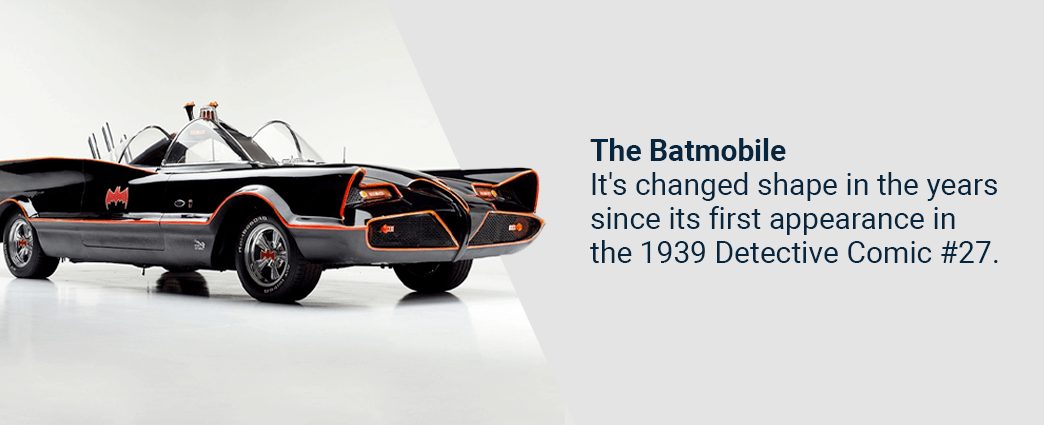
Batmobile

KITT From Knight Rider

One of the most impressive TV show vehicles is KITT from “Knight Rider.” KITT is actually two different characters in the Knight Rider canon. The first KITT, Knight Industries Two Thousand, showed up in the original series starting in 1982. Even though famous actors like David Hasselhoff and Patricia McPherson joined the show, KITT stole the screen. KITT was the souped-up, talking, bulletproof partner to Michael Knight, who was set on fighting for public justice.

The revamped KITT, short for Knight Industries Three Thousand, debuted in the 2008 “Knight Rider” reboot series. This time, KITT was based on the Ford Shelby GT500KR. The real vehicle has a 90-degree DOHC supercharged V-8 engine and 540 horsepower at 6,250 RPM. It accelerates from 0 to 60 miles per hour in 4.3 seconds. Meanwhile, the TV version can do everything from analyze DNA to light up the dark with infrared night vision headlamps.

Knight Rider car

General Lee (The Dukes of Hazzard)

Named after the Civil War Confederate commander, General Lee is the famous TV show car from “The Dukes of Hazzard.” On the show, down-home cousins Bo and Luke Duke use their tricked-up 1969 Dodge Charger to escape trouble in Hazzard County. They evade corrupt politicians and police officers during their misadventures.

The orange Charger featured a Confederate flag decal on its roof and the number “01” on each door. The car’s finishing touch is its custom air horn, which plays the first few notes of the song Dixie. Several replicas used for filming are still around today. It’s one of the easiest cars to spot thanks to its unique look.

Dukes of Hazzard Car

Starsky and Hutch Torino

The Starsky and Hutch Torino was featured in its namesake 1970s action show. Throughout the show, David Michael Starsky and Kenneth Richard Hutchinson are detective partners. They patrol Bay City, California, in a red two-door Ford Gran Torino with white stripes. Its distinctive appearance earned it the nickname “Striped Tomato.”

The Gran Torino is one of the most recognizable famous cars from movies and TV. It’s not only the car of choice for Starsky and Hutch — it’s also the title of a Clint Eastwood film about a Korean War Veteran. The character protects his prized Gran Torino from a robbery and develops an unlikely bond with the would-be thief. Of all the cool movie cars out there, the Gran Torino is one of the best-known.

Starsky and Hutch Torino
The model got its name from Turin, Italy, a city often compared to Detroit, Michigan. High-performance versions of the sedan are the base for Ford’s NASCAR entrants. Some famous drivers have used the Torino, including David Pearson, Donnie Allison and Bobby Isaac. The famous car sits somewhere between a luxury and sports vehicle.

Munster Koach (The Munsters)

One of the most unique famous TV cars is the Munster Koach, the mode of transportation for a sitcom family of monsters on “The Munsters.” The family contains Frankenstein’s monster, a few vampires and a werewolf. The car itself is a sort of Frankenstein creation, made from three Ford Model T bodies. To match the show’s theme, the car has a blood-red colored interior and a black pearl paint job.

Munster Koach
The Munster Koach also features a 10 carburetor setup, along with 10 air horns and lanterns. But its most distinct feature is its custom hearse body, which takes its horror-comedy design to the next level. It was such an iconic car that it had its own theme song from Decca Records — “Here Comes the Munster Koach.”

Its basis on the Ford Model T makes it all the more notable since the Model T was one of the first affordable, manufactured vehicles on the market. The Model T paved the way for future car designs — it was the first to have its engine block and crankcase cast as one unit and the first to have a removable cylinder head. Made from durable vanadium steel, the original version of the Model T rolled out in 1908.

Green Hornet Car (The Green Hornet)

The Green Hornet has earned a place among the original crime-fighting superheroes. He was first a radio character in the 1930s. Since then, he’s appeared in plenty of comic books, TV series and movies. The Green Hornet is the alter ego of newspaper publisher Britt Reid. He wears a green overcoat, fedora and mask and drives a 1965 Chrysler Imperial he calls The Black Beauty.

Green Hornet
The Black Beauty became one of the most famous TV and film cars thanks in part to its driver. In the 1960s TV series, The Green Hornet’s sidekick Kato is played by Martial Arts legend Bruce Lee. Lee’s character chauffeurs The Black Beauty when he’s not busy knocking down criminals.

On the show, the car had all the special features two superheroes need, including the Hornet’s Sting, which could open locked doors and set things on fire. It also had a knock-out gas gun, two rockets and a video surveillance device. It made a pretty useful tool for the crime-fighting duo.

The Saint Volvo (The Saint)

The Saint Volvo

Another famous car comes from “The Saint,” a British spy thriller series from the 1960s. The show’s hero, Simon Templar, is an outlaw with Robin Hood motives, earning him the nickname “The Saint.” He steals from the rich and gives to the poor while driving a Volvo P1800. The model’s distinctive shape made it an immediate symbol for the character. The actor who played Templar, Roger Moore, loved the car so much that he bought one for himself.

Magnum P.I. Ferrari (Magnum P.I.)

“Magnum P.I.” was a crime drama on air in the 1980s. It starred Tom Selleck as a private investigator in Hawaii. Magnum lives a luxurious lifestyle in a beachfront house nicknamed “the Robin’s Nest” after its owner, a wealthy man named Robin Masters. Magnum also has access to Masters’ car, a Ferrari 308 GTS Quattrovalvole. Later seasons of the show include Masters’ other vehicles, like an Audi 5000 and a Volkswagen Vanagon.

Magnum PI
The show’s most famous car is the flashy, bright red Ferrari, which fits the easy-going main character perfectly. Producers used three different Ferrari 308 GTS models, each of which had steel bodies and rear-wheel drive. Since Selleck is so tall, they had to adjust the vehicles to make room for him. They removed the padding from the seats and bolted them as far from the steering wheel as possible. Even still, the character almost always drives with the convertible top down to accommodate Selleck’s height.

The show’s action-packed plot caused a lot of damage to the Ferrari. It gets driven off the road, stuck in the mud, blown up with car bombs, scratched and shot at. Despite the damage it underwent, the car was impressive with 230 horsepower, a top speed of 155 miles per hour and a 0 to 60 acceleration of 6.1 seconds.

A-Team Van (The A-Team)

Another action TV series from the 1980s, “The A-Team” was a show about four former United States Army Special Forces soldiers. After serving time in military prison for a crime they didn’t commit, the team escapes to Los Angeles, California. There, they work as mercenaries as they avoid capture.

The show is famous for its cartoonish violence, simple plots and cast, including professional wrestler Mr. T. He plays Sergeant Bosco Albert “Bad Attitude” Baracus, the team’s strongman and mechanic. The other three characters include Colonel John “Hannibal” Smith, Lieutenant Templeton Peck “Faceman” and Captain “Howling Mad” Murdock.

The characters rely on their 1983 GMC Vandura van. It has a recognizable look thanks to its grey and black paint, giant red stripe and matching red turbine mag wheels. The back of the van houses whichever tools the team needs — a mini printing press, an audio surveillance recording device and a disguise kit, for example. The van is the center of some noticeable continuity errors — in some scenes, it has an obvious sunroof, while in others, it does not.

A Team Van
The van has made some appearances in pop culture. If you look closely, you’ll see it during the racing scenes of “Ready Player One,” a Stephen Spielberg movie about a virtual reality world. The van, with its unmistakable red stripe, eventually crashes off-screen. Other vehicles you can spot in the race include:

  • The Mach Five.
  • The DeLorean.
  • The Pursuit Special.

James Bond's car

James Bond’s Car (007 Series)

Although James Bond drives several different cars throughout various adaptations, the most famous is the Aston Martin DB5. The British luxury grand tourer appears in the 1964 movie “Goldfinger.” It’s one of the best movie cars, thanks to its long list of gadgets, which include:

  • Front-firing machine guns.
  • A retractable tire-shredding blade.
  • Bulletproof screens.
  • Tracking location scanners.
  • Ejector seats for unwelcome passengers.
  • An oil sprayer.
  • A smoke screen vent.
  • Revolving number plates.
  • An intelligence communication device.
  • A mine dispenser.

The Martin DB5 does not show up in the film series but reappears in “GoldenEye” and again in “Casino Royale.” Bond actors who drive the model include Sean Connery, Pierce Brosnan and Daniel Craig. It’s also the vehicle in several James Bond-themed video games, featuring a different set of gadgets. You’ll find references to the Martin DB5 in various games and films — you can buy one in Grand Theft Auto 5 with the title “JB700.”

The DeLorean Time Machine (Back to the Future)

One of the top movie cars of all time doubles as a time travel device. The DeLorean, from “Back to the Future,” sends the characters through a time-jumping wormhole. The sports car features gullwing doors and a license plate that reads “outatime.” But its core component is the flux capacitor, which makes time travel possible.

Although the real car will not let you jump through time, it has a polished look. Its fame in the “Back to the Future” franchise and its short-lived production has made it a sought-after vehicle — despite complaints of its poor driving experience.

The DeLorean time machine

Mad Max’s Pursuit Special (Mad Max)

Mad Max, the title character of the movie and video game franchise by the same name, drives a Ford GT Falcon muscle car. He calls it the “Pursuit Special” or “The Last of the V8 Interceptors.” Its most recognizable characteristic is its supercharger. The filmmakers painted it black, gave it wheel arch flares and added exhaust side pipes.

Mad Max
In the films, “Mad” Max Rockatansky is an Australian policeman in a dystopian future. He uses his Pursuit Special to chase down violent motorcycle gang members, avenging his wife and child. Throughout his adventures, he ends up helping the people he comes across. “Mad Max” is known as one of the best action series of all time.

Bandit 1 (Smokey and the Bandit)

In “Smokey and the Bandit,” acting legend Burt Reynolds handles a 1977 Pontiac Trans Am to transport bootlegged beer across the country. If Bandit (Reynolds) succeeds in transporting the beer in 28 hours or less, there’s an $88,000 prize waiting for him and his comrade Cledus, played by Jerry Reed. With Reed driving the Bandit 2 — a semi carrying all of the beer — and Carrie (Sally Field) sitting passenger next to Reynolds, the team navigates the roads and runs from the law as the Sheriff (Jackie Gleason) is hot on their tail.

The Bandit
The star-studded cast mixed with the unmatched speed and acrobatics of the Pontiac Trans Am lifted this film into iconic standing. The movie helped boost Pontiac Trans Am sales and inspired a variety of tribute cars. The Bandit 1 was painted black with gold trim, including a giant bird logo on the hood and intricate snowflake design wheels. It was a sleek, sporty design the viewer could marvel at while Reynolds jumped bridges and jammed the accelerator to evade his pursuers. “Smokey and the Bandit” and the 1977 Pontiac Trans Am will both be remembered in nostalgic relation to one another for years to come.

American Graffiti 1932 Deuce Coupe

“American Graffiti” tells the story of a group of high school graduates savoring the last days of summer vacation. Some are staying in town, and others are happily going off to college. Before they do, they cruise around town in some awesome cars, impressing passersby and drag racing.

American Graffiti 1932 Deuce Coupe
Often people think of that unique yellow car in American Graffiti — a 1932 Ford Deuce Coupe. This car and the 1955 Chevy are involved in the final drag race on a stretch of blacktop, where the Coupe wins, and the Chevy flips and ultimately explodes off the road. The movie also featured a 1958 Impala and a 1956 Thunderbird, among others.

Bullitt 1968 Ford Mustang GT

Steve McQueen plays lieutenant Frank Bullitt in this spy thriller — which is widely regarded to include one of the best and most influential car chases of all time. Bullitt’s 1968 Ford Mustang GT jumps and veers through the maze-like, steep San Francisco streets as he chases two hitmen in a Dodge Charger. It’s a scene that features no music and spans close to 10 minutes, with the primary sound effects being the raw power of the Mustang GT hopping over hills and crashing back to the pavement as McQueen — with the help of a stuntman — maneuver the powerful vehicle.

The faded green Mustang GT, with a 390-cylinder V-8 powered engine, was highly sought-after and sold for an incredible $3.4 million in January of 2020.

1968 Ford Mustang GT

Christine (John Carpenter’s Christine)

“Christine” is the cult classic that brought the 1958 Plymouth Fury to life. With its deep red colors and sharp, violent appearance, the Fury was the perfect car for Stephen King’s novel of the same name, creating the foundation for the film. Christine shows the power of owning your first car, taken to an extreme level — Arnie Cunningman, a high schooler with few friends and a craving for popularity, discovers the dilapidated 1958 Plymouth Fury in a scrap yard, where he instantly falls in love. As the movie progresses, the car changing Arnie, eventually leading to his ultimate demise.

Christine
Not many movies give such a personality and focus on a car than “Christine.” Thanks to King’s story and the movie that followed, the 1958 Plymouth Fury will always be alive in our minds, just waiting to come to life again for the right driver.

The Ecto-1 (Ghostbusters)

The Ectomobile, or the Ecto-1, was the unmistakable car used in “Ghostbusters.” It was a 1959 Cadillac Miller-Meteor ambulance conversion. When it first shows up in the movie, it’s painted black and in poor shape — Ray Stantz says he bought it for $4,800 and that it needs “some suspension work, and shocks, breaks, brake pads, lining, steering box, transmission repair” and more. In the next scene, the Ecto-1 is painted its familiar white color, the Ghostbusters logo appears on the side and wailing, flashing sirens are on its roof.

Ghostbusters Ecto

Herbie (The Love Bug)

Herbie is the loveable, self-driving 1963 Volkswagen Beetle that stars alongside Dean Jones in “The Love Bug.” With red, white and blue stripes and the number 53 on its hood and side, Herbie is one of the most identifiable cars out there. People of all generations are familiar with Herbie, as Disney has continued to remake the classic film.

Herbie the love bug
Something about the compact, fun design of the Volkswagen Beetle makes Herbie a loveable car. As the car flies past the competition and skips over water, the audience can’t help but root for him.

Place an Order With Raybuck for Restoration Parts

Cars in movies and TV shows are often just as iconic and recognizable as the characters who drive them. These cars tend to include some aspects of real engineering along with fictional qualities and gadgets. With their classic shapes and weaponized attachments, famous movie cars help their drivers fight crime, escape bad guys and make their way around.
Most fictional cars are based on real-life models, like the Lincoln Futura, Ford Model T or Aston Martin DB5. Famous movie and TV vehicles gain new life through restoration projects — if you’re restoring a vehicle, place an order with Raybuck for restoration parts. Here at Raybuck, we support economical restorations with our exact replacement parts. We also provide knowledgeable support to help you get what you need.
Categories
Repair and Replacement

When to Replace Your Car’s Weatherstripping

When to Replace Your Car's Weatherstripping

Your car or pickup truck is essential for work and your routine. Driving for thousands of miles means your vehicle could be exposed to rain, snow, debris and other contaminants, so you will need weatherstripping to keep the cabin clean. Whether you got your vehicle new or used, your weatherstripping could be due for upgrades.

It is easy to tell when you should replace the weatherstripping on your car. Taking care of the problem as soon as possible helps prevent rust and mold from accumulating on interior surfaces.

Where Is There Weatherstripping on My Vehicle?

You will find automotive weatherstripping close to doors, windows and windshields. Just look for black rubber materials near these installations to find the weatherstripping on your model. Weatherstripping sits on automotive parts that open and close, and around windows and vents. Your vehicle’s weatherstripping should leave a tight seal between the inside of the cabin and the elements.

Drivers often wonder, when you replace auto doors or glass, do you also replace weatherstripping? You should at least inspect weatherstripping sections to see they are in working condition. Installations that have visible tears or fading surfaces should be replaced for a pleasant driving experience.

Common Signs to Replace Car Weatherstripping

How often you replace weatherstripping will depend on where your vehicle is stored, outside conditions and your driving applications. There are several indicators that it’s time for replacements:

1. Cabin Leaks

Water trickling inside your vehicle is a telltale sign your weatherstripping is outdated. You may notice water droplets inside the cabin while you are driving in inclement weather or after your car has been sitting for days.

Weatherstripping can lift from vehicle surfaces. This can happen because heat or freezing temperatures cause the seals to lift, or something catches the rubber materials resulting in a tear. Cabin leaks could be minor or severe depending on the size of gaps.

Because mold is a significant threat to you and your passengers, you should replace weatherstripping across your car before puddles create mold spots on seats and carpets, or the moisture penetrates our porous surfaces (like a headliner) within the cabin.

2. Excessive Road Noise

Weatherstripping blocks water and dirt from entering the vehicle, but it also helps to quiet the cabin. Slight road noise should be expected when driving at faster speeds. If your tires seem louder than usual, this is a common sign you should inspect weatherstripping. Or, if you’ve started hearing a whistling sound, your weatherstripping may be cracked or torn, and air is making its way into the cabin.

Remember to look at your vehicle’s rear doors and windows, too. It takes time to find the source of the weatherstripping problem, but having someone ride in the back seat will help you identify which sections call for attention.

3. Loss of Heat or Air Conditioning

In extreme warm or cold temperatures, you want your vehicle’s air conditioning and heat to function properly. If you notice your car or truck doesn’t hold comfortable air, your heating or air unit might not be the issue. Instead, your weatherstripping could be the cause for concern.

To see if your weatherstripping is the issue, have your heat or air running until the cabin is comfortable, then shut it off. If your vehicle doesn’t retain the warm or cool air for long, you could have worn weatherstripping.

There is a chance the hot or cool air coming from vents is escaping the cabin due to holes in weatherstripping. Cabin seals act as insulation and are responsible for preventing inside air from moving through open spaces. Replacing the weatherstripping on car doors could resolve the problem.

4. Visible Deterioration Across Weatherstripping

Visible Deterioration Across Weatherstripping

Walk around your vehicle, and look closely at weatherstripping sections. Visible holes or dents across weatherstripping pieces tell you your installations have seen better days.

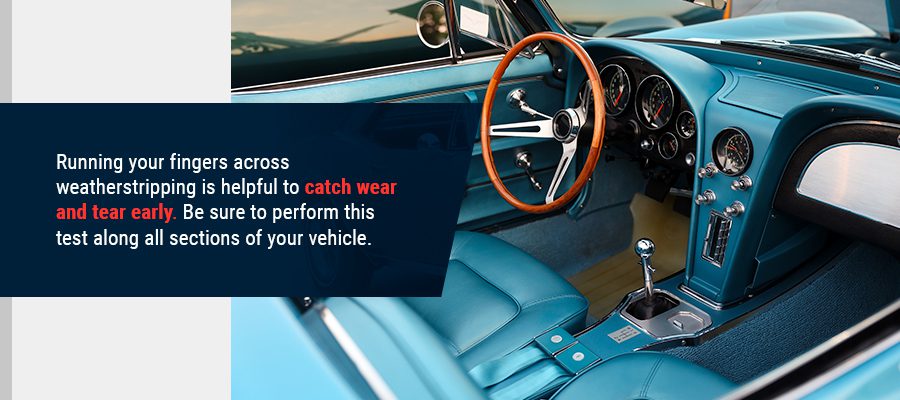
Running your fingers across weatherstripping is helpful to catch wear and tear early. Be sure to perform this test along all sections of your vehicle. Consider marking worn seals with tape so you can monitor their condition between seasons.

5. Brittle Weatherstripping

You can spot faulty weatherstripping by looking at it. If rubber materials appear dry and sections flake apart, automotive weatherstripping replacements are in order.

Car and truck seals should be soft. Press in on weatherstripping sections to verify they can change shape like a cushion. Brittle installations will have a hard time keeping water, pollen and mud outside the vehicle. Seals that look deflated or droop off the sides of a car or truck should be repaired or replaced as needed.

6. Older Vehicles and Weatherstripping

Vehicles that are 25 years or older should have weatherstripping replaced. Original adhesives and rubber materials on older cars weaken over time. Consider yourself lucky if you drive a classic car or truck and the factory seals still work. Changing out the weatherstripping materials on your vehicle can improve the appearance and comfort of your automobile.

Testing the Integrity of Automotive Weatherstripping

It is possible to test the condition of automotive weatherstripping. You can perform a quick assessment to see whether or not your current installations are preventing air and contaminants from making their way inside the cabin. All you need is a dollar bill to complete the test:

  1. Move to one of your vehicle’s doors.
  2. Open the door. Shut the door with half of the dollar exposed near the roof.
  3. Try to slide the dollar out by pulling it upward.

You can tell if your seals are working properly if there is resistance on the dollar bill. You should have trouble lifting the dollar from between the door. A dollar that slides right out from the seal indicates a weak spot in your weatherstripping. Repeat the test around each door and your trunk compartment.

Look at the dollar bill once you finish the test. Sticky residues tell you the weatherstripping is failing and needs to be replaced.

Maintaining Your Vehicle’s Weatherstripping

You can prevent weatherstripping sections from wearing away by cleaning surfaces. Wipe down seals occasionally since it only takes a few moments. Taking these steps keeps installations clear of dirt and spots:

  1. Fill a bucket with water.
  2. Add a small amount of detergent to the bucket.
  3. Use a cloth to scrub vehicle seals lightly.
  4. Rinse off the seals leaving no suds behind.
  5. Leave car or truck doors open to help seals dry.
  6. Once the weatherstripping is dry to the touch, you may shut the doors.

Weatherstripping conditioners and lubricants help prolong the life of seals. Spray directly on weatherstripping or apply using a cloth for desirable results.

Get Your Weatherstripping Materials From Raybuck Auto Body Parts

Get Your Weatherstripping Materials From Raybuck Auto Body Parts

You will find all sorts of weatherstripping replacement kits with the Raybuck Auto Body Parts. Upgrade the existing seals on your favorite car or pickup truck with our solutions for Chevrolet, GMC, Ford, Dodge models and others. We offer competitive pricing, and we have a great customer service team that can assist with your restoration project.

Check out our weatherstripping solutions today. You can also contact us with questions you have about installing or maintaining your purchases.

Categories
Chevy/GMC Project Builds Tech Articles Truck Talk

How to Build a Bed Wood Floor for a First-Series Chevy or GMC Truck

How to Build a Bed Wood Floor for a First-Series Chevy or GMC Truck

All Chevrolet and GMC trucks left the factory with bed wood materials through the early 1970s. The planks met with cross sills and reinforcement strips for a finished look. If your first-series Chevy or GMC truck needs restoration work, follow the instructions below to see how you can make a new wood truck bed yourself.

Materials You’ll Need

You can buy flooring kits with planks in the correct dimensions for Chevy and GMC trucks, but some owners choose materials individually for personalized results.

The number of wooden boards originally included in Chevy and GMC trucks changed throughout production. For example, a 1957 Chevy truck bed contains eight wooden boards, while models from the 1940s have nine. Verify your truck’s production year to determine the number of wooden boards you’ll need. Here’s a general guide:

  • 1947-early 1951 trucks: Nine wooden boards
  • Late 1951-1972 stepside trucks: Eight wooden boards
  • 1973-1987 stepside trucks: Seven wooden boards

You’ll also need a series of metal bed strips, metal angle strips, and cross sills. Some cross sills bolt to the truck frame and some will only bolt to the bedsides.

Make sure you have the following tools:

  • Tape measure
  • Power drill
  • Electric saw
  • Router

Chevy and GMC Wood Truck Bed Plank Dimensions

The sizes of the original wood planks depend on your vehicle’s model year. These pieces will also look different based on whether your truck follows a stepside or fleetside layout. If available, measure the existing planks in your truck bed to determine the length and width of updated planks. If the wood has rotted away, you should still be able to measure the distance between the mounting holes on the bed cross sills.

Chevy first-series trucks should have a 1/16″ gap between bed strip edges and raised sections of wooden materials to account for expansion. Select wood boards that are 3/4″ thick. Check out the information below to see specific widths for specific model years.

1947-early 1951 first-series trucks: 

  • 4 1/4″
  • 5″
  • 5 1/2″
  • 5 1/2″
  • 6 3/8″
  • 5 1/2″
  • 5 1/2″
  • 5″
  • 4 1/4″

Late 1951-1955 first-series trucks: 

  • 4 1/4″
  • 7 1/4″
  • 5″
  • 7 1/4″
  • 7 1/4″
  • 5″
  • 7 1/4″
  • 4 1/4″

Product Links

The lengths of first-series beds changed according to payload capacity. Most beds from the first-series Chevy and GMC era were either 77″ or 85 3/4″ in length. The 1/2-ton bed models were equipped with shorter planks than the 3/4-ton builds.

The Sizes of the Original Wood

About Bed Plank Board Grooves

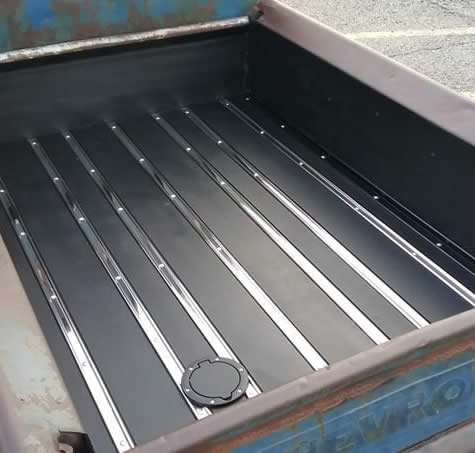
Original Chevy truck beds featured metal strips that helped secure the wood planks to the cross sills. Automotive enthusiasts identify these metal materials as wear strips, or bed strips. To install bed strips, you’ll need to make sure the planks have grooves so you can fasten them securely.

Some may think that the wood planks were bolted directly to the cross sills, but they are not. Using bed strips to secure the wood allows the wood planks to expand and contract with temperature and moisture changes. General Motors was careful in deciding the bed plank board groove dimensions as engineers wanted to ensure the wooden beds could get wet without buckling or separating from the supports below them.

Outer bed planks require grooves on the inside edges. All connecting boards in between should have grooves on both sides. We recommend buying bed strips before cutting your planks to size. The smaller you make your grooves, the more the metal strips will stick out above the bed wood.

Outer Bed Planks Groove Dimensions

Use these dimensions to cut grooves in centerboards that are 3/4″ in thickness:

  • 1/8″ for the inside groove
  • 1/4″ at the bottom for the bed strip
  • 1/4″ for the outside groove

The metal bed strips should sit higher up in comparison to the wooden planks. This layout reduces the chance of loading materials landing in the crevices of boards, which can cause premature wear.

Steps to Building a Chevy or GMC Wood Truck Bed

Use the guide below to finish your truck bed restoration job:

  1. Gather the dimensions of your bed frame.
  2. Cut the wooden planks to size.
  3. Use a router or table saw to cut the grooves along each plank side.
  4. Lay the wooden planks from left to right over the bed frame.
  5. Position metal bed strips between the planks.
  6. Thread fastening bolts through the metal strips down in between planks.
  7. Install a metal angle strip along both sides. These strips bolt to the cross sills and not the bedsides. They secure the outside edge of the two outer wood planks.
  8. Fasten your installations using hardware nuts.
  9. Make adjustments as needed until the planks are completely straight.

Purchase Bed Strip Kits From Raybuck Auto Body Parts

Raybuck Auto Body Parts will help you restore your first-series Chevy or GMC truck with rust repair panels and other components. You can bring your vehicle back to like-new condition by ordering automotive parts today.

Our team is here to help you decide on restoration solutions. Reach out to learn more about Chevy and GMC parts.

Categories
Chevy/GMC

History of the Chevy Chevelle

History of the Chevy Chevelle

The Chevy Chevelle remains a classic staple of the car industry. The mid-sized muscle car has had a long and winding history with various models and designs, each adding uniqueness and personality. It’s one of the most popular models Chevrolet ever sold, and was a best-selling model of its era. The third generation body style has even inspired some NASCAR vehicles to be designed with the Chevelle in mind.

Quick Links:

Versions ranging from coupes and sedans to convertibles and stations wagons were all part of the Chevelle evolution. Super Sports (SSs) were a huge hit, produced for many years until the Laguna replaced it in the 1970s. While the El Camino was rejuvenated under the Chevelle lineup, the Monte Carlo resembled many aspects of the Chevelle. Eventually, the Malibu was a top-selling model and replaced the Chevelle name in the late 1970s, retiring the classic car.

The Chevelle is a central part of auto culture and American culture in general, showing up repeatedly in films and shows with its iconic twin stripes and powerful, sleek design. It’s a centerpiece in the movie “Jack Reacher,” featuring a car chase scene with Tom Cruise throttling the engine of a Chevelle and weaving through traffic. “The Other Guys,” “Charlie’s Angels” and other media also feature the Chevelle.

But aside from its modern inspirations and pop culture appearances, what makes the Chevelle truly interesting is its evolution and impact on the auto industry itself.

The Chevy Chevelle: Beginnings

Because of its lean yet powerful design, some believe the name “Chevelle” was derived from a combination of “Chevrolet” and “gazelle,” though that’s never been confirmed. However, what’s true is that Chevrolet wanted to create their own mid-sized vehicle to compete with other similar cars on the market. The Chevy Chevelle met and exceeded that expectation, creating a phenomenon all on its own.

As you move through the Chevelle timeline, you can see how the vehicle evolved to fit performance, comfort, driving and regulatory standards during the tail-end of its evolution.

Chevy Chevelle and gazelle

First Generation (1963-1967)

Themes of variety, experimentation and heated competition marked the first generation of the Chevy Chevelle. The car industry was often engaged in various battles for popularity during the 1960s, trying to outdo one another for the best model on the market. Chevrolet found its golden product in the Chevy Chevelle, with the first generation stretching from 1963 to 1967.

Genesis (1963-1964)

Chevrolet first introduced the Chevelle in 1963. Though production started in 1963, a standard 1963 Chevelle typically isn’t included in the known range of Chevelle models. The introductory models of the Chevelle had a short life span. The Chevelle was a new and heated rival to the Fairlane, Ford’s own version of a mid-sized vehicle.

Being muscular but not overly bulky, the Chevy Chevelle offered an excellent option that bridged the gap between Chevy’s Impala and the Chevy II/Nova. While the Impala was larger and bulkier, the Nova was made for compactness. The Chevelle was a middle ground between these models, showcasing a variety of body styles ranging from sport coupe to station wagon.

Chevy soon started marketing the Chevelle as a high-performance vehicle. In 1964, a 327 engine that produced up to 300 horsepower overtook the original 220 horsepower engine. With the numerous styles and models of the first-generation Chevy Chevelle, there was a lot to love. The Chevelle offered a lot of versatility for a car that looked nice and had excellent performance standards — families could display it proudly in their driveways while testing out its horsepower during rides around town.

The throwback 115-inch wheelbase created an easy, smooth ride. This, paired with the general size of the Chevelle, made it easy to transport passengers, another reason families would look into buying one. But despite the car’s perks, competition within the muscle car niche soon became fierce. Chevy would quickly be pushed into even higher performance standards, ushering in the era of the Chevelle SS.

First Generation of the Chevy Chevelle

1965 Z16

In 1965, the Chevelle’s horsepower increased to 375 with an optional L37 engine. This engine was used in all Z16 Chevelle models, though Chevrolet produced only a select few — just 201 Chevy Z16 SSs were made with the L37 engine. These cars were distributed to celebrities and General Motors executives, and few actually made it to dealerships to be sold to consumers.

The Z16 displayed improved handling and traction with its updated rear-axle suspension, and its manual transmission gave more power and feel to the driver. Chevrolet was also determined to create a casual driver’s identity for the Chevelle. This wasn’t a racing car meant for just performance, but rather a flexible, diversified vehicle that a variety of people would enjoy driving.

The Chevelle made use of a vast array of Chevrolet’s latest comforts and gadgets, including a tachometer, a 160 mile-per-hour speedometer, front and rear seat belts, an AM/FM radio, padded dash and an adjustable driver’s side mirror. The Z16 blended comfort, power, elegance and muscle to create a beautiful performance vehicle. It changed the landscape of muscle cars and built a new era of design for comfort and performance.

1966 SS 396

In 1966, Chevrolet left the Z16 model behind, cementing the 201 models as rarities in Chevelle history. The new SS 396 was equipped with a 396 engine capable of 375 horsepower, but the main change to the 1966 Chevelle was its design. The taillights and fenders were redesigned to make the Chevelle look a bit sleeker, and a new roof line was added with an inset rear window. Another major change was the grille — it came “blacked out,” a stark change from the look of earlier models.

The new model also emphasized safety, adding a warning light for brake failure and a collapsible steering column in case of collision. A tachometer was placed to the right of the speedometer and was known to knock against the knee of the driver — something Chevy would correct the next year.

1967

The changes from 1966 to 1967 were slight, but adjustments were made to improve aesthetics and performance. Tailights were touched up and became narrower and taller. The SS 396 badges were placed on the center of the grill. On the inside, the tachometer was moved to the left of the speedometer for driver comfort. However, it also completely blocked the left turn signal and partially blocked the gas gauge. New options also included front-disk brakes.

The 396 engine was carried over from 1966 and was used as the standard engine for this year. Ultimately, the 1967 Chevelle marked the end of the first generation of the Chevy Chevelle. After this model, it became something truly different.

Shop First Generation Chevy Chevelle Parts »

Second Generation (1968-1972)

The second generation invited a new look for the Chevy Chevelle. The new generation gave a smoother, more modern feel to the Chevelle, adding a sleekness that flattened out the bulkier and boxier parts of the original models. The wheelbase was cut, making the hood longer and the back deck shorter. The second generation — primarily the LS6 model — brought huge upgrades to performance, marking this generation as the most powerful Chevelle years. Though the second generation brought some of the most classic looks and feels to the Chevy Chevelle, the tail-end of it also intertwined with the world of government regulations and lead to the inevitable close of the Chevelle era.

1968-1969

The year 1968 delivered the Chevelle’s first redesigns. With a long hood, sculpted body and tapered fenders paired with the same 375 horsepower 396 engine, the new Chevelle gave drivers even more reason to proudly coast the streets. The vent window was removed and a chrome bar was installed across the grill.

1970 LS6

This model is often touted as one of the best Chevelle years. It created the classic Chevy Chevelle look displayed in movies and shows. For the LS6, taillights were mounted to the bumper and two twin racing stripes appeared on its hood.

The power of the LS6 was infamous, ranking as one of the most powerful horsepower cars of the era. With the addition of the new 454 engine, this Chevelle boasted 450 horsepower. Drivers could upgrade the car’s performance even more with a new air scoop for cowl induction.

Though the LS6 was beloved by drivers, it only lasted through 1970 and was retired to a short and sweet Chevelle history.

1971

This year marked the end of a golden age. Competition for greater horsepower was cut short as the government cracked down on gas-guzzling vehicles and began to emphasize more sustainable engines.

The Chevelle’s body style changed as well, as the twin headlamps from the previous year were condensed into one arrangement, turn signals were moved to the corner fenders and square taillights were replaced with rounded versions similar to the Camaro of that era.

The new “Heavy Chevy” was introduced with a domed hood, lock pins and a V8 engine, all at an affordable price for the Chevelle.

1972

1972 brought minor changes to the Chevelle, including slight adjustments to parking lights. The redesigned plans for the new Chevelle were postponed one year due to a strike, and it wasn’t until 1973 the Chevelle undertook a new style.

Shop Second Generation Chevy Chevelle Parts »

Third Generation (1973-1977)

In the third generation of the Chevy Chevelle, external factors began to creep in and affect the design and performance of models. The designs and engines changed to adapt, so the iconic look of the second generation was ultimately left behind. The late 1970s marked the end for the Chevrolet Chevelle, and its name was replaced with the Chevy Malibu in 1977. Gone were the days of the performance boosts of the second and first generations — instead these years rolled out appearance packages without the powerful engines that once accompanied earlier models.

1973

1973 brought a complete redesign. Pressured by more government regulations and an oil embargo, performance standards dipped significantly. The design reflected a “colonnade,” with frameless glass doors and supportive structures for safety in case of a rollover accident. Disk brakes became the new standard for all models.

The central theme of 1973 was a focus on safety and adherence to the political landscape and regulations. This safety focus was a stark contrast from the days of the past when the goal was performance and appearance.

1974-1977

After 1973, replacements and new names came to cloud the Chevelle, paving the way for a future of more efficient cars. The Chevelle was slowly being phased out, not in design and structure but more so in name. There was no cancellation of the Chevelle line, merely a rebranding and restructuring.

In 1974, Chevrolet replaced the SS with the Laguna Type S3. In 1975, the last big-block Chevelles retired, highlighting the finality of muscle and performance vehicles.

Many consider 1977 to be Chevelle’s final year, as it was the last time the Chevelle name was used before being entirely replaced by the Chevy Malibu. In 1978, the Chevelle went through one more redesign that officially changed its identity, and the Malibu took center stage.

Shop Third Generation Chevy Chevelle Parts »

1978 Chevy Chevelle

What Was the Best Chevelle Year?

There were many good years for the Chevy Chevelle, whether you determine that by sales, looks or performance. It’s an often subjective topic that’s unique to each person’s perspective.

If you go through Chevelle models by year, the first generation of the Chevelle produced some of the most classic 1960s Chevelle models that paved the way for more to come. The Z16 changed the game for muscle cars and blended comfort with performance. The high suspension mixed with the assortment of gadgets made driving those early versions a treat and a way to take pride in your vehicle. The Z16 also was the rarest model, with only 201 made.

However, the second generation drastically improved performance and gave us some of the most iconic Chevy models. The 1970 model, boasting the most powerful Chevelle complete with the newly added stripes, remains one of the favorites of many Chevelle connaisseurs. The third generation still saw plenty of popularity and design changes. Still, it may not be looked at as fondly as the first or second nostalgic generations, as government regulations and embargos affected it.

Ultimately, the best year of the Chevelle is a choice only you can make.

Restoration Parts From Raybuck Auto Body Parts

If you own a Chevy Chevelle, you could be looking to restore your vehicle to the high-class product it was back in the day. The Chevelle has a long and fabled history, and restoring a Chevelle to its former appearance can be like traveling back in time to that moment in history.

Raybuck Auto Body Parts can help you restore your vehicle and bring it back to the glory days. It doesn’t matter what model you have — we can find the right parts for you and help you get on the path to complete restoration.

From interior parts like dash pads, door panels and seat covers to heavier materials like steel tanks and hoses, Raybuck Auto Body Parts has a vast selection to help you with all of your restoration needs. These products include rust-removers, paints and adhesives, creating a one-stop-shop to satisfy our customers.

Raybuck has been providing quality restoration parts since 1985, so we’re the trusted industry professionals who can give you everything you need at a reasonable cost. Let our expert team field your questions and provide in-depth answers to support your restoration needs. Contact us today!

Restoration Parts from Raybuck Auto Body Parts

Categories
Chevy/GMC

History of the Chevy Nova 

History of the Chevy Nova

The Chevy Nova, originally known as the Chevy II, had a prosperous and impactful run throughout Chevrolet history, cycling through six generations before retiring. The Nova met consumer demand and proved to be a popular car for decades.

Other Chevy models like the Chevelle or Camaro sometimes overshadowed the Nova, stealing its sales. An urban myth claimed the Nova didn’t sell well in Spanish-speaking countries because of its name (Nova is similar to the Spanish phrase “no va” which literally translates as “doesn’t go”) — a legend proven to be false. For the most part, the Nova was a staple part of Chevy’s lineup and provided a reliable compact car option for drivers everywhere.

But why was the Chevrolet Nova so successful and long-lived?

After a notorious genesis of rushed and cost-effective production, it’s interesting to look at the qualities and factors that went into making this one of the most classic Chevy models ever.

Quick Links:

The Beginnings of the Chevy Nova

At the time, Chevrolet was falling behind and needed a small, functional vehicle to compete with the era’s compact cars, such as the highly successful Ford Falcon. The Chevy Corvair didn’t get the success Chevrolet was looking for, so the Nova was an attempt to create something lasting and reliable.

There seemed to be some question as to what to call this compact car, and the first Nova produced rolled off the production line under the name Chevy II — a simple name for a simple car.

The early 1960s saw one of the quickest Chevrolet car productions ever, designing and building an automobile line in record time and at low cost. Rushing through the process to maintain their hold on the compact car market, Chevrolet watched their new vehicle go on sale and hoped for an enthusiastic response.

First Generation — 1962-1965

Smaller than most Chevy vehicles but larger than the Corvair, the new Chevy II was available as a four-door sedan, convertible, station wagon or two-door coupe. The Chevy II Nova 400 was the sportiest option, with a 120 horsepower, six-cylinder engine. The car offered smooth driving in a sensible version that appealed to many people.

Overall, the car was mainly functional, reflecting the initial purpose and goal of Chevrolet’s rushed production, but some performance options soon became available in the next year.

The Chevy Nova was smooth to drive

1963

1963 introduced the world to the Super Sport RPO Z03 package, paired with the Chevy II Nova 400. The package put more emphasis on design than performance. The new trim, added bucket seats, new gadgets and upgraded steering wheel lifted the compact car into the realm of sportiness in appearance, but its performance was lagging.

1964

Chevrolet introduced a new 283-cubic-inch V-8 engine to the Nova, bumping the horsepower to 195 and later 220. This performance boost put a muscle car label on the Nova, allowing it to go from zero to 60 in 11.3 seconds. Chevy also introduced a “Turbo-Thrift” option, offering a 230-cylinder engine that produced 155 horsepower.

Even with the performance upgrades and the array of options, Nova sales took a nosedive after the introduction of the brand-new Chevelle, Chevy’s version of a performance-based muscle car.

1965 brought expansion, as Chevrolet continued to boost performance on the Nova with the V-8 327 engine capable of 250 and 300 horsepower.

Shop First Generation Chevy Nova Parts »

Second Generation — 1966-1967

Of all the Chevy Nova generations, the 1966-1967 era may be the briefest, but it also created a new and faster vehicle.

Little separated the second generation from the first, save more minor trim features, sheet metal makeovers and performance boosts. A new 327 eight-cylinder engine made the Nova capable of 350 horsepower.

Shop Second Generation Chevy Nova Parts »

The Chevy Nova is capable of 350 horsepower

Third Generation — 1968-1972

The third generation, starting in 1968, introduced a complete redesign of the Chevy II Nova. It was a similar style to the Chevelle, with a semi-fastback styling and 111-inch wheelbase.

The Nova SS, fitted with a standard 350-cubic-inch V-8 engine, generated similar horsepower as earlier models and resembled the Camaro.

The L34 and L78 models continued to highlight the Nova as an effective muscle car, with the L78 generating 375 horsepower. Both these models were relatively rare, with few produced and sold. Still, they remain vital pieces of Nova history and stepping stones toward a legit performance-based vehicle.

This generation’s most powerful model was the Yenko Nova. It came with a 427-cubic-inch eight-cylinder engine and 425 horsepower. The Yenko Nova was extremely rare, with fewer than 40 ever made.

1969 — The Nova Is Born

In 1969, Chevy Nova replaced Chevy II as the sole name of Chevrolet’s prized compact car. From then on, the Chevy Nova would be the only name used, sometimes appearing in brochures and magazines as merely “Nova.”

The next couple of years would mostly see engine changes without any real performance benefit, causing Nova sales to drop slightly. After the performance enhancements at the start of the second generation, new upgrades to horsepower began to taper off. The Clean Air Act of 1970 also started cracking down on performance-based cars, causing Chevy to throttle back on gas-guzzling, roaring engines.

The automaker discontinued their higher-performance models and began devising a new strategy for the fourth-generation Chevy Novas.

Shop Third Generation Chevy Nova Parts »

Fourth Generation — 1973-1974

Government regulations impacted the fourth-generation Novas and returned the vehicle to a simpler, more functional car. In 1973, Chevy downgraded the SS model and started offering options for any engine, with the most effective being the 175-horsepower 350. Chevrolet also introduced a new hatchback version of the two-door Nova.

Safety regulations created changes in Nova body styles, with bigger, sturdier bumpers, new taillights and seat belts for driver and passenger protection.

Chevy unveiled the “Spirit of America” Nova model in 1974, with red, white and blue stripes painted on the hood and trailing over the entire car. The interior also featured red and blue fabrics. The model celebrated the upcoming bicentennial in 1976, a fun and unique way to include the Nova in a piece of history. It proved to be a hot new collector’s item for car connoisseurs.

The fourth generation came and went quickly, highlighted only by a few downgrades to meet regulations, safety additions and the classic “Spirit of America” model in 1974. Ultimately, this era marked the end of muscle cars and created a line of vehicles based more on safety than performance.

Shop Fourth Generation Chevy Nova Parts »

Fifth Generation — 1975-1979

The fifth generation of the Chevy Nova saw extensive changes and highlighted a long and changing journey from the Nova’s genesis as a simplistic compact car.

Style changes made the Nova look a bit boxier, though it retained its smooth, semi-fastback shape. These newer models also included catalytic converters to combat emissions, disc brakes and steel-belted radial tires.

One model completely changed the perspective on the Nova, as it addressed the era’s current climate and consumer values. Chevy introduced a luxury option in 1975, meeting the demand for small, intimate and classy-looking vehicles. This model, dubbed the “Luxury Nova,” came equipped with large, comfy seats almost resembled lounge chairs, along with sound insulation and several other characteristics that put the Nova in a new category of almost European-style luxury car excellence.

Chevy met the era’s emissions standards with low horsepower, usually ranging in the 100s, with reliable, trusted engines respecting environmental regulations.

Chevrolet canceled Nova SS production in 1977, marking the end of a dynasty of blended performance and functionality. Many believe this generation to be the last, and most recognize it as such. However, a brief stint in the following years created the need for a sixth and peculiar generation of the Chevy Nova.

Shop Fifth Generation Chevy Nova Parts »

Sixth Generation — 1985-1988

The sixth generation ushered in a new era for Chevy Nova history. General Motors and Toyota teamed up to create a subcompact version of the Nova.

Though the Nova had already evolved significantly with the addition of the luxury model, the car had always been quintessentially American. As demonstrated by the symbolism of its “Spirit of America” model in 1974, the Nova seemed intent on staying an American car. However, this iteration was a far journey from the old days of the Nova and a remarkable identity shift.

Shop Sixth Generation Chevy Nova Parts »

New United Manufacturing Motor Incorporated

The Nova’s sixth generation was another step in the vehicle’s evolution, this time extending a hand across the Pacific to strike a new partnership with Japan. The joint venture was part of New United Manufacturing Motor Incorporated, an agreement that started in 1984 and closed up shop in 2010, shutting the door on a fascinating learning experience for both parties. The deal gave Toyota a manufacturing facility in California. In turn, GM would learn how Toyota ran an effective production line with minimal costs. This fruitful relationship produced the 1985 Chevy Nova, a rebirth of the classic compact car.

The new Novas had the same style as the Toyota Corollas, with a four-cylinder engine and an automatic transmission. Low on horsepower, this car aimed for functionality over performance. Clearly, this was miles away from the earlier models and a result of a brand-new production strategy. Styles came in four-door notchback sedans and five-door hatchbacks. The following years included various minor style changes and a sportier model in 1988 with a four-wheel drive.

But 1988 was the last time the Nova name ever appeared on a brand-new vehicle. In September, production stopped, and Chevrolet went in a different direction, putting a final stamp on this model’s long and successful run.

New United Manufacturing Motor Incorporated

What Was the Best Chevy Nova Year?

You might not find as much consensus among car aficionados about the best Chevy Nova years as you would for models like a Chevelle. Some cars have specific model years that stand out, with jacked-up performance or enhanced looks. As you scan the Chevy Nova timeline, it’s maybe a little harder to determine because of the broad ranges of models the car went through.

Indeed, the Chevelle and Camaro may have overshadowed the Nova at several points. Still, the Nova was always a behind-the-scenes bestseller, offering the performance and function to create a reliable, effective vehicle. Chevy fought through regulations and competitors and kept evolving, changing with the times and moving for survival.

In later years, the Nova even became a product of foreign designs, a 180-degree turn from its moment of fame as the “Spirit of America” model honoring the 1976 bicentennial. But throughout the entire Chevy Nova evolution, is there one year that stands out?

The Best Chevy Nova

If you value power and performance, the third-generation Chevy Nova models could be your favorites, as these came out at the peak of the muscle car era before regulations invaded. The unique Yenko Nova could be your favorite, proudly displaying an eight-cylinder engine with 450 horsepower.

Or the 1969 version could stand out to you, serving as the first vehicle to fully take on the Nova name and retire Chevy II forever.

The ’70s Nova showed fewer improvements, but featured the red, white and blue classic that still exists as a potential collector’s item. If you value luxury, comfort and unique, personalized vehicles, 1975 could be your favorite year, as it presented the Luxury Nova, with upscale class emphasized above all else.

Alternatively, you might view the ’60s Nova as the best, reflecting quickly innovated products made in response to new rivals of compact cars.

Or, that last and unique sixth generation running through the mid-to-late ’80s could stick out to you, with its historic partnership between Toyota and GM and the creation of NUMMI.

Whatever your standards or preferences, the “best” year of the Chevy Nova is ultimately subjective and up for interpretation.

Restore Your Vehicle With Raybuck Auto Body Parts

Owning or restoring an old Chevy Nova can be highly rewarding, but it can prove challenging if you don’t have the right parts or materials to get the job done. You’ll want to get your Nova in mint condition and restore it to the classic, performance-driven car it once was.

Raybuck Auto Body Parts can help you in that restoration process. We offer a wide range of parts and materials to aid you in your projects, from interior items like dash pads and floor panels to steel tanks and fuel neck filler hoses.

Whatever you’re looking for or need help with, our expert team can help you find and provide answers to your questions. We’ve spent the last 26 years crafting our product line and ensuring our customers get the very best. We’ll help bring back your vehicle’s former glory while giving you the care and attention you deserve. Contact us today!

Restore your vehicle with Raybuck Auto Body Parts